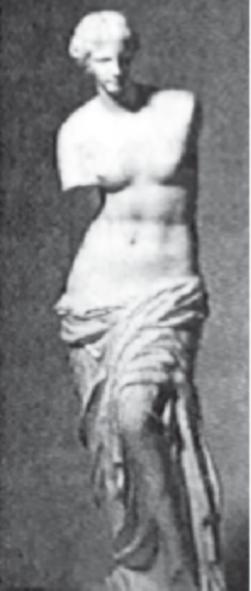
1.古希腊时期,人们认为最美人体的头顶至肚脐的长度与肚脐至足底的长度之比是 $ \dfrac{\sqrt{5}-1}{2} $ ( $ \dfrac{\sqrt{5}-1}{2}\approx 0.618 $ ,称为黄金分割比例),著名的“断臂维纳斯”便是如此.此外,最美人体的头顶至咽喉的长度与咽喉至肚脐的长度之比也是 $ \dfrac{\sqrt{5}-1}{2} $ .若某人满足上述两个黄金分割比例,且腿长为 $ 105\text{ }\mathrm{c}\mathrm{m} $ ,头顶至脖子下端的长度为 $ 26\text{ }\mathrm{c}\mathrm{m} $ ,则其身高可能是( )
A. $ 165\text{ }\mathrm{c}\mathrm{m} $
B. $ 175\text{ }\mathrm{c}\mathrm{m} $
C. $ 185\text{ }\mathrm{c}\mathrm{m} $
D. $ 190\text{ }\mathrm{c}\mathrm{m} $
如图,设“某人”头顶至肚脐的长度为 $ a\text{ }\mathrm{c}\mathrm{m} $ ,肚脐至足底的长度为 $ b\text{ }\mathrm{c}\mathrm{m} $ ,头顶至咽喉的长度为 $ c\text{ }\mathrm{c}\mathrm{m} $ ,咽喉至肚脐的长度为 $ d\text{ }\mathrm{c}\mathrm{m} $ ,则
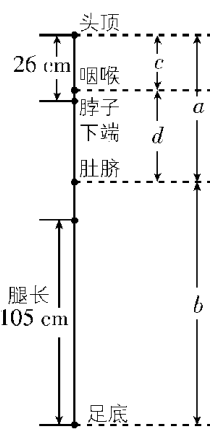
$ \dfrac{a}{b}=\dfrac{c}{d}=\dfrac{\sqrt{5}-1}{2}\approx 0.618 $ ,
$ c < 26 $ , $ b > 105 $ , $ c+d=a $ .
设“某人”的身高为 $ h\text{ }\mathrm{c}\mathrm{m} $ ,即 $ a+b=h $ .
由 $ \begin{cases}b > 105,\\ a\approx 0.618b,\end{cases} $ 解得 $ a > 64.89 $ ,
由 $ \begin{cases}c < 26,\\ c\approx 0.618d,\end{cases} $ 解得 $ d < 42.07 $ ,
所以 $ c+d < 26+42.07=68.07 $ ,即 $ a < 68.07 $ .
$ \begin{cases}a < 68.07,\\ a\approx 0.618b,\end{cases} $ 解得 $ b < 110.15 $ .
整理可得 $ 64.89+105 < a+b < 68.07+110.15 $ ,即 $ 169.89 < h < 178.22 $ ,结合选项可知其身高可能是 $ 175\text{ }\mathrm{c}\mathrm{m} $ .故选 $ \mathrm{B} $ .
2.若 $ a > 0 $ , $ b > 0 $ ,则 $ \dfrac{1}{a}+\dfrac{a}{{b}^{2}}+b $ 的最小值为 .
$ 2\sqrt{2} $
由题意可知 $ \dfrac{1}{a}+\dfrac{a}{{b}^{2}}+b\geqslant 2\sqrt{\dfrac{1}{a}\cdot \dfrac{a}{{b}^{2}}}+b\geqslant 2\sqrt{\dfrac{2}{b}\cdot b}=2\sqrt{2} $ ,当且仅当 $ \dfrac{1}{a}=\dfrac{a}{{b}^{2}} $ 时,第一个“ $ = $ ”成立,当且仅当 $ \dfrac{2}{b}=b $ 时,第二个“ $ = $ ”成立,即 $ a=b=\sqrt{2} $ 时,等号同时成立, $ \dfrac{1}{a}+\dfrac{a}{{b}^{2}}+b $ 取得最小值,为 $ 2\sqrt{2} $ .
3.已知 $ 5{x}^{2}{y}^{2}+{y}^{4}=1(x,y\in \boldsymbol{R}) $ ,则 $ {x}^{2}+{y}^{2} $ 的最小值是 .
$ \dfrac{4}{5} $
由 $ 5{x}^{2}{y}^{2}+{y}^{4}=1 $ ,可得 $ {x}^{2}=\dfrac{1-{y}^{4}}{5{y}^{2}} $ ,由 $ {x}^{2}\geqslant 0 $ ,可得 $ 0 < {y}^{2}\leqslant 1 $ ,
则 $ {x}^{2}+{y}^{2}=\dfrac{1-{y}^{4}}{5{y}^{2}}+{y}^{2}=\dfrac{1+4{y}^{4}}{5{y}^{2}}=\dfrac{1}{5}(4{y}^{2}+\dfrac{1}{{y}^{2}})\geqslant \dfrac{1}{5}\cdot 2\sqrt{4{y}^{2}\cdot \dfrac{1}{{y}^{2}}}=\dfrac{4}{5} $ ,当且仅当 $ {y}^{2}=\dfrac{1}{2} $ , $ {x}^{2}=\dfrac{3}{10} $ 时,等号成立,
故 $ {x}^{2}+{y}^{2} $ 的最小值为 $ \dfrac{4}{5} $ .
4.已知实数 $ a $ , $ b $ 满足 $ a+b\geqslant 3 $ .
证明: $ 2{a}^{2}+2{b}^{2} > a+b $ .
【证明】因为 $ a+b\geqslant 3 > 1 $ ,所以 $ 2{a}^{2}+2{b}^{2}={a}^{2}+{b}^{2}+ ({a}^{2}+{b}^{2} )\geqslant {a}^{2}+{b}^{2}+2ab= (a+b)^{2} > a+b $ .
5.已知集合 $ M={-2 $ , $ -1 {\rm ,0,1} $ , $ 2} $ , $ N={x|{x}^{2}-x-6\geqslant 0} $ ,则 $ M\cap N= $ ( )
A. $ {-2 $ , $ -1 {\rm ,0} $ , $ 1} $
B. $ {0,1,2} $
C. $ {-2} $
D. $ {2} $
由 $ {x}^{2}-x-6\geqslant 0 $ ,得 $ x\leqslant -2 $ 或 $ x\geqslant 3 $ ,则 $ N={x|x\leqslant -2 $ 或 $ x\geqslant 3}.\because M={-2 $ , $ -1 {\rm ,0,1} $ , $ 2} $ , $ \therefore M\cap N={-2} $ ,故选 $ \mathrm{C} $ .
6.已知集合 $ A={x|{x}^{2}-3x-4 < 0} $ , $ B={-4,1,3,5} $ ,则 $ A\cap B= $ ( )
A. $ {-4,1} $
B. $ {1,5} $
C. $ {3,5} $
D. $ {1,3} $
由不等式 $ {x}^{2}-3x-4 < 0 $ ,解得 $ -1 < x < 4 $ ,则 $ A={x|-1 < x < 4} $ .又 $ B={-4,1,3,5} $ ,所以 $ A\cap B={1,3} $ ,故选 $ \mathrm{D} $ .
1.已知二次函数 $ y={x}^{2}+ax+b(a,b\in \boldsymbol{R}) $ 的图象过点 $ (-2,m) $ , $ (t,0) $ ,且 $ 4\leqslant m\leqslant 5 $ , $ -1\leqslant t\leqslant 1 $ ,则( )
A. $ -3\leqslant b\leqslant -\dfrac{2}{3} $
B. $ -3\leqslant b\leqslant 0 $
C. $ -\dfrac{2}{3}\leqslant b\leqslant 9-4\sqrt{5} $
D. $ -3\leqslant b\leqslant 9-4\sqrt{5} $
由题意, $ m=4-2a+b $ ,令 $ y=(x-c)(x-t) $ ,则由根与系数的关系知, $ c+t=-a $ , $ ct=b $ ,故 $ m=4+2(c+t)+ct $ ,又 $ 4\leqslant m\leqslant 5 $ ,则 $ -2t\leqslant c(2+t)\leqslant 1-2t $ .
因为 $ -1\leqslant t\leqslant 1 $ ,所以 $ -\dfrac{2t}{2+t}\leqslant c\leqslant \dfrac{1-2t}{2+t} $ ,
当 $ -1\leqslant t < 0 $ 时, $ \dfrac{(1-2t)t}{2+t}\leqslant ct\leqslant -\dfrac{2{t}^{2}}{2+t} $ ,即存
在 $ -1\leqslant t < 0 $ 使 $ \dfrac{(1-2t)t}{2+t}\leqslant b\leqslant -\dfrac{2{t}^{2}}{2+t} $ ,
记 $ u=t+2 $ , $ 1\leqslant u < 2 $ ,则 $ \dfrac{(1-2t)t}{2+t}=-(2u+\dfrac{10}{u}-9) $ , $ -\dfrac{2{t}^{2}}{2+t}=-2(u+\dfrac{4}{u}-4) $ ,又 $ y=2u+\dfrac{10}{u} $ 与 $ y=u+\dfrac{4}{u} $ 在 $ {u|1\leqslant u < 2} $ 上均随 $ u $ 的增大而减小,故 $ 0 > \dfrac{(1-2t)t}{2+t}\geqslant -3 $ ,
$ -2\leqslant -\dfrac{2{t}^{2}}{2+t} < 0 $ ,故 $ -3\leqslant b < 0 $ .
当 $ 0\leqslant t\leqslant 1 $ 时, $ -\dfrac{2{t}^{2}}{2+t}\leqslant b\leqslant \dfrac{(1-2t)t}{2+t} $ ,同理可
得 $ 0\geqslant -\dfrac{2{t}^{2}}{2+t}\geqslant -\dfrac{2}{3} $ , $ -\dfrac{1}{3}\leqslant \dfrac{(1-2t)t}{2+t}\leqslant 9-4\sqrt{5} $ ,故 $ -\dfrac{2}{3}\leqslant b\leqslant 9-4\sqrt{5} $ .
综上所述, $ -3\leqslant b\leqslant 9-4\sqrt{5} $ .故选 $ \mathrm{D} $ .
2.若 $ (2x-1)y\leqslant 4{x}^{2}-2x+m $ 对满足 $ 0\leqslant x\leqslant y\leqslant 1 $ 的任意实数 $ x $ , $ y $ 恒成立,则( )
A. $ m\geqslant -1 $
B. $ m\geqslant \dfrac{1}{8} $
C. $ -1\leqslant m\leqslant \dfrac{1}{8} $
D. $ -\dfrac{26}{9}\leqslant m\leqslant -1 $
分离参变量得 $ m\geqslant (2x-1)(y-2x) $ 恒成立,则 $ m\geqslant [(2x-1)(y-2x)]_{ \max } $ ,故右式取最大值时 $ 2x-1 $ , $ y-2x $ 必须同号(且都不为零),此时 $ x < \dfrac{1}{2} $ ,因为若 $ x > \dfrac{1}{2} $ ,则 $ 2x-1 > 0 $ , $ y-2x $ 与其同号,则 $ y > 1 $ ,与已知矛盾.由 $ 0\leqslant x\leqslant y\leqslant 1 $ ,设 $ y=tx(1\leqslant t) $ ,则 $ (2x-1)(y-2x)=\dfrac{2-t}{2}\cdot 2x(1-2x) $ ,若要求 $ (2x-1)(y-2x) $ 取最大值,则需 $ \dfrac{2-t}{2} > 0 $ ,即 $ 1\leqslant t < 2 $ ,此时 $ (2x-1)(y-2x)=\dfrac{2-t}{2}\cdot 2x(1-2x)\leqslant \dfrac{2-t}{2}\cdot {\left(\dfrac{2x+1-2x}{2}\right) ^ {2}}=\dfrac{2-t}{8}\leqslant \dfrac{1}{8} $ ,当且仅当 $ \begin{cases}2-t > 0,\\ 1-2x=2x,\\ t=1,\end{cases} $ 即 $ x=y=\dfrac{1}{4} $ 时等号成立,所以 $ m\geqslant \dfrac{1}{8} $ .故选 $ \mathrm{B} $ .
3.已知 $ a\in \boldsymbol{R} $ ,关于 $ x $ 的不等式 $ |{x}^{3}+1|+|{x}^{3}-1|\geqslant (ax-8)|x| $ 的解集为 $ X $ .
(1) 若 $ a=16 $ ,求 $ X $ ;
(2) 若 $ X=\boldsymbol{R} $ ,求实数 $ a $ 的取值范围.
(1) 【解】由 $ a=16 $ ,得 $ 16x|x|\leqslant |{x}^{3}+1|+|{x}^{3}-1|+8|x| $ .
当 $ x\leqslant 0 $ 时, $ 16x|x|\leqslant 0 $ , $ |{x}^{3}+1|+|{x}^{3}-1|+8|x|\geqslant |{x}^{3}+1|+|{x}^{3}-1|\geqslant |{x}^{3}+1-{x}^{3}+1|=2 $ (当且仅当 $ x=0 $ 时等号成立),不等式成立.
当 $ 0 < x < 1 $ 时, $ 0 < {x}^{3} < 1 $ ,则 $ 16{x}^{2}\leqslant 2+8x $ ,即 $ 8{x}^{2}-4x-1\leqslant 0 $ ,则 $ 0 < x\leqslant \dfrac{1+\sqrt{3}}{4} $ .
当 $ x\geqslant 1 $ 时, $ {x}^{3}\geqslant 1 $ ,则 $ 16{x}^{2}\leqslant 2{x}^{3}+8x $ ,即 $ {x}^{2}-8x+4\geqslant 0 $ ,解得 $ x\geqslant 4+2\sqrt{3} $ .
综上可知,不等式的解集 $ X={x|x\leqslant \dfrac{1+\sqrt{3}}{4} $ 或 $ x\geqslant 4+2\sqrt{3}} $ .
(2) 【解】由题意知,不等式 $ ax|x|\leqslant |{x}^{3}+1|+|{x}^{3}-1|+8|x| $ 对任意 $ x\in \boldsymbol{R} $ 恒成立,
若 $ x=0 $ ,则 $ 0\leqslant 2 $ 恒成立,即 $ a\in \boldsymbol{R} $ .
若 $ x > 0 $ ,则 $ a\leqslant |x+\dfrac{1}{{x}^{2}}|+|x-\dfrac{1}{{x}^{2}}|+\dfrac{8}{x} $ 恒成立,
又 $ |x+\dfrac{1}{{x}^{2}}|+|x-\dfrac{1}{{x}^{2}}|+\dfrac{8}{x}\geqslant |(x+\dfrac{1}{{x}^{2}})+(x-\dfrac{1}{{x}^{2}})|+\dfrac{8}{x}=2(x+\dfrac{4}{x})\geqslant 8 $ ,当且仅当 $ x=2 $ 时等号成立,故 $ a\leqslant 8 $ .
若 $ x < 0 $ ,则 $ -a\leqslant |x+\dfrac{1}{{x}^{2}}|+|x-\dfrac{1}{{x}^{2}}|+\dfrac{8}{|x|} $ 恒成立,
因为 $ |x+\dfrac{1}{{x}^{2}}|+|x-\dfrac{1}{{x}^{2}}|+\dfrac{8}{|x|}\geqslant |(x+\dfrac{1}{{x}^{2}})+(x-\dfrac{1}{{x}^{2}})|+\dfrac{8}{|x|}=2(|x|+\dfrac{4}{|x|})\geqslant 8 $ ,当且仅当 $ x=-2 $ 时等号成立,故 $ -a\leqslant 8 $ ,即 $ a\geqslant -8 $ .
综上,实数 $ a $ 的取值范围为 $ {a|-8\leqslant a\leqslant 8} $ .