课时1 函数的单调性
一、刷基础
1.下列说法正确的是( )
A.所有的函数在其定义域上都具有单调性
B.若函数 $ y=f(x) $ 在区间 $ [1,3] $ 上单调递减,则函数 $ y=f(x) $ 的单调递减区间是 $ [1,3] $
C.若函数 $ f(x) $ 为 $ \boldsymbol{R} $ 上的减函数,则 $ f(-3) > f(3) $
D.若函数 $ y=f(x) $ 在定义域上有 $ f(1) < f(2) $ ,则函数 $ y=f(x) $ 是增函数
答案:C
解析:对于 $ \mathrm{A} $ ,函数 $ y=\dfrac{1}{x} $ 在其定义域 $ (-\mathrm{\infty },0)\cup (0,+\mathrm{\infty }) $ 上不具有单调性,故 $ \mathrm{A} $ 错误;
对于 $ \mathrm{B} $ ,函数 $ f(x)=-{x}^{2} $ 在区间 $ [1,3] $ 上单调递减,但 $ f(x) $ 的单调递减区间是 $ [0,+\mathrm{\infty }) $ ,故 $ \mathrm{B} $ 错误;
对于 $ \mathrm{C} $ ,函数 $ f(x) $ 为 $ \boldsymbol{R} $ 上的减函数,因为 $ -3 < 3 $ ,所以 $ f(-3) > f(3) $ ,故 $ \mathrm{C} $ 正确;
对于 $ \mathrm{D} $ ,函数 $ f(x)=-{\left(x-2\right) ^ {2}} $ , $ f(1)=-1 $ , $ f(2)=0 $ ,满足 $ f(1) < f(2) $ ,但 $ f(x)={-(x-2)}^{2} $ 在 $ (-\mathrm{\infty },2] $ 上单调递增,在 $ [2,+\mathrm{\infty }) $ 上单调递减,
所以 $ f(x) $ 在其定义域 $ \boldsymbol{R} $ 上不是增函数,故 $ \mathrm{D} $ 错误.故选 $ \mathrm{C} $ .
2.(多选)函数 $ y=f(x) $ 是 $ (0,+\mathrm{\infty }) $ 上的减函数,且 $ 0 < {x}_{1} < {x}_{2} $ ,则下列选项正确的是( )(多选)
A. $ f({x}_{1}) > f({x}_{2}) $
B. $ f({x}_{1})-f({x}_{2}) > 0 $
C. $ ({x}_{1}-{x}_{2})[f({x}_{1})-f({x}_{2})] < 0 $
D. $ \dfrac{f({x}_{1})-f({x}_{2})}{{x}_{1}-{x}_{2}} > 0 $
答案:ABC
解析: $ \mathrm{A} $ , $ \mathrm{B} $ 选项, $ y=f(x) $ 是 $ (0,+\mathrm{\infty }) $ 上的减函数,且 $ 0 < {x}_{1} < {x}_{2} $ ,故 $ f({x}_{1}) > f({x}_{2}) $ ,则 $ f({x}_{1})-f({x}_{2}) > 0 $ , $ \mathrm{A} $ , $ \mathrm{B} $ 正确;
$ \mathrm{C} $ , $ \mathrm{D} $ 选项,因为 $ {x}_{1}-{x}_{2} < 0 $ , $ f({x}_{1})-f({x}_{2}) > 0 $ ,所以 $ ({x}_{1}-{x}_{2})[f({x}_{1})-f({x}_{2})] < 0 $ ,
$ \dfrac{f({x}_{1})-f({x}_{2})}{{x}_{1}-{x}_{2}} < 0 $ , $ \mathrm{C} $ 正确, $ \mathrm{D} $ 错误.
故选 $ \mathrm{A}\mathrm{B}\mathrm{C} $ .
3.“函数 $ f(x) $ 在区间 $ [1,2] $ 上不是增函数”的一个充要条件是( )
A.“存在 $ a $ , $ b\in [1,2] $ ,使得 $ a < b $ 且 $ f(a)=f(b) $ ”
B.“存在 $ a $ , $ b\in [1,2] $ ,使得 $ a < b $ 且 $ f(a)\geqslant f(b) $ ”
C.“存在 $ a\in (1,2] $ ,使得 $ f(a)\leqslant f(1) $ ”
D.“存在 $ a\in (1,2) $ ,使得 $ f(a)\geqslant f(2) $ ”
答案:B
解析:若函数 $ f(x) $ 在区间 $ [1,2] $ 上是增函数,即任意 $ a $ , $ b\in [1,2] $ ,使得 $ a < b $ 且 $ f(a) < f(b) $ ,则若函数 $ f(x) $ 在区间 $ [1,2] $ 上不是增函数,即存在 $ a $ , $ b\in [1,2] $ ,使得 $ a < b $ 且 $ f(a)\geqslant f(b) $ .故选 $ \mathrm{B} $ .
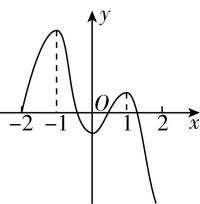
4.如图是函数 $ y=f(x) $ 的图象,其定义域为 $ [-2,+\mathrm{\infty }) $ ,则函数 $ f(x) $ 的单调递减区间是( )
A. $ [-1,0) $
B. $ [1,+\mathrm{\infty }) $
C. $ [-1,0) $ , $ [1,+\mathrm{\infty }) $
D. $ [-1,0)\cup [1,+\mathrm{\infty }) $
答案:C
解析:若函数单调递减,则对应图象呈下降趋势,则由题图知, $ f(x) $ 的单调递减区间为 $ [-1,0) $ , $ [1,+\mathrm{\infty }) $ ,故选 $ \mathrm{C} $ .
5.(多选)下列函数中,在区间 $ (-\mathrm{\infty },0) $ 上单调递增的是( )(多选)
A. $ f(x)=-\dfrac{1}{x} $
B. $ f(x)=x $
C. $ f(x)=-{x}^{2} $
D. $ f(x)=1-x $
答案:ABC
解析:作出 $ y=-\dfrac{1}{x} $ , $ y=x $ , $ y=-{x}^{2} $ , $ y=1-x $ 的图象如图所示,则由函数的图象知 $ y=-\dfrac{1}{x} $ , $ y=x $ , $ y=-{x}^{2} $ 在 $ (-\mathrm{\infty },0) $ 上单调递增, $ y=1-x $ 在 $ (-\mathrm{\infty },0) $ 上单调递减.故选 $ \mathrm{A}\mathrm{B}\mathrm{C} $ .

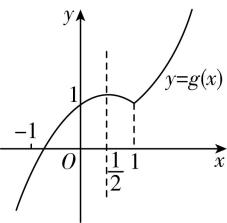
6.函数 $ g(x)=x|x-1|+1 $ 的单调递减区间为( )
A. $ (-\mathrm{\infty },\dfrac{1}{2}] $
B. $ [\dfrac{1}{2},1] $
C. $ [1,+\mathrm{\infty }) $
D. $ (-\mathrm{\infty },\dfrac{1}{2}]\cup [1,+\mathrm{\infty }) $
答案:B
解析: $ g(x)=x\mid x-1\mid +1=\begin{cases}{x}^{2}-x+1,x\geqslant 1,\\ -{x}^{2}+x+1,x < 1,\end{cases} $ 作出函数 $ g(x) $ 的大致图象,如图所示,由图可知函数 $ g(x) $ 的单调递减区间为 $ [\dfrac{1}{2},1] $ .故选 $ \mathrm{B} $ .
7.设函数 $ f(x) $ 为 $ \boldsymbol{R} $ 上的增函数,则下列结论正确的是( )
A. $ y=xf(x) $ 在 $ \boldsymbol{R} $ 上为增函数
B. $ y=\dfrac{f(x)}{x} $ 在 $ \boldsymbol{R} $ 上为减函数
C. $ y=-\dfrac{1}{f(x)} $ 在 $ \boldsymbol{R} $ 上为增函数
D. $ y=-f(x) $ 在 $ \boldsymbol{R} $ 上为减函数
答案:D
解析:由题设, $ f(x)=x $ 满足要求,则 $ y=\dfrac{f(x)}{x}=1 $ 为常数函数且定义域不是 $ \boldsymbol{R} $ ,故排除 $ \mathrm{B} $ ;
$ y=xf(x)={x}^{2} $ , $ y=-\dfrac{1}{f(x)}=-\dfrac{1}{x} $ 在 $ \boldsymbol{R} $ 上不是单调函数,且函数 $ y=-\dfrac{1}{x} $ 的定义域不是 $ \boldsymbol{R} $ ,故排除 $ \mathrm{A} $ , $ \mathrm{C} $ ;
若函数 $ f(x) $ 在 $ \boldsymbol{R} $ 上为增函数,则 $ y=-f(x) $ 在 $ \boldsymbol{R} $ 上为减函数, $ \mathrm{D} $ 正确.故选 $ \mathrm{D} $ .
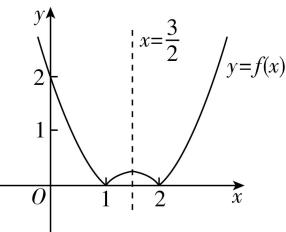
8.函数 $ f(x)=|{x}^{2}-3x+2| $ 的单调递减区间是 .
答案: $ (-\mathrm{\infty },1) $ , $ (\dfrac{3}{2},2) $
解析:当 $ x\geqslant 2 $ 或 $ x\leqslant 1 $ 时, $ f(x)={x}^{2}-3x+2 $ , $ f(x) $ 图象的对称轴方程为 $ x=\dfrac{3}{2} $ ,
当 $ 1 < x < 2 $ 时, $ f(x)=-{x}^{2}+3x-2 $ , $ f(x) $ 图象的对称轴方程为 $ x=\dfrac{3}{2} $ ,
作出 $ f(x) $ 的图象如图所示,
由图可知, $ f(x) $ 的单调递减区间为 $ (-\mathrm{\infty },1) $ , $ (\dfrac{3}{2},2) $ .
9.已知函数 $ f(x)=\dfrac{ax+b}{{x}^{2}+1} $ 且经过 $ (-1,-1) $ , $ (\dfrac{1}{2},\dfrac{4}{5}) $ 两点.
(1) 求函数 $ f(x) $ 的解析式;
(2) 利用单调性的定义证明: $ f(x) $ 在 $ (-1,1) $ 上单调递增.
答案:(1) 【解】将点 $ (-1,-1) $ , $ (\dfrac{1}{2},\dfrac{4}{5}) $ 的坐标代入解析式得 $ \begin{cases}\dfrac{-a+b}{1+1}=-1,\\ \dfrac{\dfrac{1}{2}a+b}{{\left(\dfrac{1}{2}\right)}^{2}+1}=\dfrac{4}{5},\end{cases} $
解得 $ \begin{cases}a=2,\\ b=0,\end{cases} $ 故 $ f(x)=\dfrac{2x}{{x}^{2}+1} $ .
(2) 【证明】任取 $ {x}_{1} $ , $ {x}_{2}\in (-1,1) $ ,且 $ {x}_{1} < {x}_{2} $ ,
则 $ f({x}_{1})-f({x}_{2})=\dfrac{2{x}_{1}}{{x}_{1}^{2}+1}-\dfrac{2{x}_{2}}{{x}_{2}^{2}+1} $
$ =\dfrac{2{x}_{1}{x}_{2}^{2}+2{x}_{1}-2{x}_{2}{x}_{1}^{2}-2{x}_{2}}{({x}_{1}^{2}+1)({x}_{2}^{2}+1)} $
$ =\dfrac{2{x}_{1}{x}_{2}({x}_{2}-{x}_{1})-2({x}_{2}-{x}_{1})}{({x}_{1}^{2}+1)({x}_{2}^{2}+1)} $
$ =\dfrac{2({x}_{1}{x}_{2}-1)({x}_{2}-{x}_{1})}{({x}_{1}^{2}+1)({x}_{2}^{2}+1)} $ ,
因为 $ {x}_{1} $ , $ {x}_{2}\in (-1,1) $ , $ {x}_{1} < {x}_{2} $ ,所以 $ {x}_{1}{x}_{2}-1 < 0 $ , $ {x}_{2}-{x}_{1} > 0 $ ,
故 $ f({x}_{1})-f({x}_{2})=\dfrac{2({x}_{1}{x}_{2}-1)({x}_{2}-{x}_{1})}{({x}_{1}^{2}+1)({x}_{2}^{2}+1)} < 0 $ ,
故 $ f({x}_{1}) < f({x}_{2}) $ ,所以 $ f(x) $ 在 $ (-1,1) $ 上单调递增.
解析:
10.函数 $ f(x)=|x|+\dfrac{1}{x} $ 的大致图象是( )
A.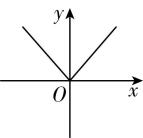
B.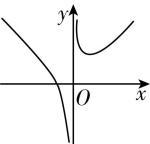
C.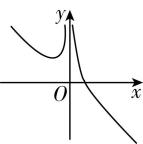
D.
答案:B
解析:函数 $ f(x)=|x|+\dfrac{1}{x} $ 的定义域为 $ {x|x\ne 0} $ ,且 $ f(x)=\begin{cases}-x+\dfrac{1}{x},x < 0,\\ x+\dfrac{1}{x},x > 0,\end{cases} $
当 $ x < 0 $ 时,因为函数 $ y=-x $ , $ y=\dfrac{1}{x} $ 在 $ (-\mathrm{\infty },0) $ 上都单调递减,所以函数 $ f(x)=-x+\dfrac{1}{x} $ 在 $ (-\mathrm{\infty },0) $ 上单调递减.
当 $ x > 0 $ 时,由对勾函数的单调性可知,函数 $ f(x)=x+\dfrac{1}{x} $ 在 $ (0,1) $ 上单调递减,在 $ (1,+\mathrm{\infty }) $ 上单调递增,故符合函数 $ f(x) $ 的图象为 $ \mathrm{B} $ 选项中的图象.故选 $ \mathrm{B} $ .
11.函数 $ y=f(x) $ 为定义在 $ \boldsymbol{R} $ 上的减函数,若 $ a\ne 0 $ ,则( )
A. $ f(a) > f(2a) $
B. $ f({a}^{2}) > f(a) $
C. $ f({a}^{2}+a) < f(a) $
D. $ f({a}^{2}+a) > f(a+1) $
答案:C
解析: $ y=f(x) $ 是定义在 $ \boldsymbol{R} $ 上的减函数, $ a\ne 0 $ , $ a $ 与 $ 2a $ 的大小关系不能确定,从而 $ f(a) $ , $ f(2a) $ 的大小关系不确定,故 $ \mathrm{A} $ 错误.
$ {a}^{2}-a=a(a-1) $ ,当 $ a < 0 $ 或 $ a > 1 $ 时, $ {a}^{2} > a $ ;当 $ 0 < a < 1 $ 时, $ {a}^{2} < a $ ,故 $ f({a}^{2}) $ , $ f(a) $ 的大小关系不确定,故 $ \mathrm{B} $ 错误.
$ \because {a}^{2}+a-a={a}^{2} > 0 $ , $ \therefore {a}^{2}+a > a $ , $ \therefore f({a}^{2}+a) < f(a) $ ,故 $ \mathrm{C} $ 正确.
$ {a}^{2}+a-a-1={a}^{2}-1=(a+1)(a-1) $ ,当 $ a < -1 $ 或 $ a > 1 $ 时, $ {a}^{2}+a > a+1 $ ;当 $ 0 < a < 1 $ 时, $ {a}^{2}+a < a+1 $ ,故 $ f({a}^{2}+a) $ , $ f(a+1) $ 的大小关系不确定, $ \mathrm{D} $ 错误.故选 $ \mathrm{C} $ .
12.若函数 $ f(x)=-{x}^{2}+4ax $ 与 $ g(x)=\dfrac{2x-a+1}{x-2a} $ 在区间 $ [1,2] $ 上都单调递减,则实数 $ a $ 的取值范围是( )
A. $ (-\dfrac{1}{3},\dfrac{1}{2}) $
B. $ (-\dfrac{1}{2},1] $
C. $ (-\dfrac{1}{2},\dfrac{1}{3}] $
D. $ (-\dfrac{1}{2},\dfrac{1}{2}) $
答案:A
解析:由题意,函数 $ f(x)=-{x}^{2}+4ax $ 的图象对应的抛物线开口向下,对称轴为直线 $ x=2a $ ,故 $ f(x) $ 在 $ [2a,+\mathrm{\infty }) $ 上单调递减,
若 $ f(x) $ 在区间 $ [1,2] $ 上单调递减,则 $ 2a\leqslant 1 $ ,解得 $ a\leqslant \dfrac{1}{2} $ .
函数 $ g(x)=\dfrac{2x-a+1}{x-2a}=\dfrac{2(x-2a)+3a+1}{x-2a}=2+\dfrac{3a+1}{x-2a} $ ,若 $ g(x) $ 在区间 $ [1,2] $ 上单调递减,则 $ 3a+1 > 0 $ ,且 $ 2a < 1 $ 或 $ 2a > 2 $ ,即 $ -\dfrac{1}{3} < a < \dfrac{1}{2} $ 或 $ a > 1 $ .
综上,实数 $ a $ 的取值范围是 $ (-\dfrac{1}{3},\dfrac{1}{2}) $ ,故选 $ \mathrm{A} $ .
13.已知函数 $ f(x)=\sqrt{x+1}-\sqrt{1-x} $ ,则不等式 $ f(x+1) > f(2x) $ 的解集为( )
A. $ (-\mathrm{\infty },1) $
B. $ (-\mathrm{\infty },1] $
C. $ [-\dfrac{1}{2},0] $
D. $ [-\dfrac{1}{2},1) $
答案:C
解析:函数 $ f(x)=\sqrt{x+1}-\sqrt{1-x} $ ,由 $ \begin{cases}x+1\geqslant 0,\\ 1-x\geqslant 0,\end{cases} $ 解得 $ -1\leqslant x\leqslant 1 $ ,则 $ f(x) $ 的定义域为 $ [-1,1] $ .
因为 $ y=\sqrt{x+1} $ 是增函数, $ y=-\sqrt{1-x} $ 也是增函数,
所以 $ f(x)=\sqrt{x+1}-\sqrt{1-x} $ 是 $ [-1,1] $ 上的增函数,
由不等式 $ f(x+1) > f(2x) $ 得 $ \begin{cases}-1\leqslant x+1\leqslant 1,\\ -1\leqslant 2x\leqslant 1,\\ x+1 > 2x,\end{cases} $ 解得 $ -\dfrac{1}{2}\leqslant x\leqslant 0 $ ,故选 $ \mathrm{C} $ .
14.若函数 $ f(x)=\begin{cases}\dfrac{1}{x},x < a,\\ \mid x+2\mid ,x\geqslant a\end{cases} $ 在 $ (-\mathrm{\infty },a) $ 上单调递减,在 $ (a,+\mathrm{\infty }) $ 上单调递增,则实数 $ a $ 的取值范围是( )
A. $ [2,+\mathrm{\infty }) $
B. $ [-2,+\mathrm{\infty }) $
C. $ [0,2] $
D. $ [-2,0] $
答案:D
解析:函数 $ f(x)=\begin{cases}\dfrac{1}{x},x < a,\\ \mid x+2\mid ,x\geqslant a,\end{cases} $ 根据反比例函数的性质可得 $ y=\dfrac{1}{x} $ 在区间 $ (-\mathrm{\infty },0) $ 上单调递减,要使函数 $ f(x) $ 在区间 $ (-\mathrm{\infty },a) $ 上单调递减,则 $ a\leqslant 0 $ .
由 $ f(x)=\left|x+2\right| $ 在 $ (a,+\mathrm{\infty }) $ 上单调递增,得 $ a+2\geqslant 0 $ ,解得 $ a\geqslant -2 $ .故实数 $ a $ 的取值范围是 $ [-2,0] $ .故选 $ \mathrm{D} $ .
15.已知定义在 $ \boldsymbol{R} $ 上的函数 $ f(x) $ 满足 $ f(x+y)=f(x)+f(y)+2 $ , $ f(1)=2 $ ,且当 $ x > 0 $ 时, $ f(x) > -2 $ ,则不等式 $ f({x}^{2}+x)+f(1-2x) > 8 $ 的解集为( )
A. $ {x|x < -2 $ 或 $ x > 1} $
B. $ {x|x < -1 $ 或 $ x > 2} $
C. $ {x|-1 < x < 2} $
D. $ {x|-2 < x < 1} $
答案:B
解析:已知 $ f(x+y)=f(x)+f(y)+2 $ , $ f(1)=2 $ ,
令 $ x=y=1 $ ,则 $ f(2)=f(1)+f(1)+2=6 $ ,
令 $ x=2 $ , $ y=1 $ ,则 $ f(3)=f(2)+f(1)+2=10 $ .
令 $ x={x}_{2} $ , $ y={x}_{1}-{x}_{2} $ ,且 $ {x}_{1} > {x}_{2} $ ,则 $ f({x}_{1})=f({x}_{2})+f({x}_{1}-{x}_{2})+2 $ ,
整理得 $ f({x}_{1})-f({x}_{2})=f({x}_{1}-{x}_{2})+2 $ ,
因为 $ {x}_{1} > {x}_{2} $ ,所以 $ {x}_{1}-{x}_{2} > 0 $ ,可得 $ f({x}_{1}-{x}_{2}) > -2 $ ,
所以 $ f({x}_{1})-f({x}_{2})=f({x}_{1}-{x}_{2})+2 > 0 $ ,即 $ f({x}_{1}) > f({x}_{2}) $ ,
可知 $ f(x) $ 在 $ \boldsymbol{R} $ 上单调递增.
又 $ f({x}^{2}+x)+f(1-2x) > 8 $ ,即 $ f({x}^{2}+x)+f(1-2x)+2 > 10 $ ,
可得 $ f({x}^{2}+x+1-2x) > f(3) $ ,即 $ f({x}^{2}-x+1) > f(3) $ ,
结合 $ f(x) $ 在定义域 $ \boldsymbol{R} $ 上单调递增,可得 $ {x}^{2}-x+1 > 3 $ ,解得 $ x < -1 $ 或 $ x > 2 $ ,
所以不等式 $ f({x}^{2}+x)+f(1-2x) > 8 $ 的解集为 $ {x|x < -1 $ 或 $ x > 2} $ .故选 $ \mathrm{B} $ .
16.定义在 $ (0,+\mathrm{\infty }) $ 上的函数 $ f(x) $ 满足:①当 $ x > 1 $ 时, $ f(x) > 0 $ ;②对任意实数 $ x $ , $ y $ 都有 $ f(x\cdot y)=f(x)+f(y) $ .
(1) 证明:当 $ 0 < x < 1 $ 时, $ f(x) < 0 $ ;
(2) 判断 $ f(x) $ 在 $ (0,+\mathrm{\infty }) $ 上的单调性;
(3) 解不等式 $ f(x+1)+f(2x-3) > 0 $ .
答案:(1) 【证明】令 $ x=y=1 $ ,则 $ f(1)=f(1)+f(1) $ ,所以 $ f(1)=0 $ .
当 $ 0 < x < 1 $ 时, $ \dfrac{1}{x} > 1 $ ,则 $ f(\dfrac{1}{x}) > 0 $ ,
在 $ f(x\cdot y)=f(x)+f(y) $ 中,
令 $ y=\dfrac{1}{x} $ ,则 $ f(1)=f(x)+f(\dfrac{1}{x}) $ ,所以 $ f(x)=-f(\dfrac{1}{x}) < 0 $ .
(2) 【解】设 $ 0 < {x}_{1} < {x}_{2} $ ,则 $ \dfrac{{x}_{2}}{{x}_{1}} > 1 $ ,所以 $ f(\dfrac{{x}_{2}}{{x}_{1}}) > 0 $ ,
于是 $ f({x}_{2})=f({x}_{1}\cdot \dfrac{{x}_{2}}{{x}_{1}})=f({x}_{1})+f(\dfrac{{x}_{2}}{{x}_{1}}) > f({x}_{1}) $ ,
故 $ f(x) $ 在 $ (0,+\mathrm{\infty }) $ 上单调递增.
(3) 【解】由题意知,原不等式等价于 $ f((x+1)(2x-3)) > f(1) $ ,
由(2)知, $ f(x) $ 在 $ (0,+\mathrm{\infty }) $ 上单调递增,可得 $ (x+1)(2x-3) > 1 $ ,且 $ x+1 > 0 $ , $ 2x-3 > 0 $ ,解得 $ x > \dfrac{1+\sqrt{33}}{4} $ .
故原不等式的解集是 $ (\dfrac{1+\sqrt{33}}{4},+\mathrm{\infty }) $ .
解析:
17.若函数 $ f(x)=k{x}^{2}+(3k-2)x-5 $ 在 $ (-\mathrm{\infty },1] $ 上单调递减,则实数 $ k $ 的取值范围是 .
解析:当 $ k=0 $ 时, $ f(x)=-2x-5 $ ,显然此函数在 $ (-\mathrm{\infty },1] $ 上单调递减;
当 $ k\ne 0 $ 时,函数 $ f(x) $ 图象的对称轴为直线 $ x=-\dfrac{3k-2}{2k} $ ,要使函数 $ f(x) $ 在 $ (-\mathrm{\infty },1] $ 上单调递减,
只需满足 $ \begin{cases}k > 0,\\ -\dfrac{3k-2}{2k}\geqslant 1,\end{cases} $ 解得 $ 0 < k\leqslant \dfrac{2}{5} $ .
综上所述,实数 $ k $ 的取值范围是 $ [0,\dfrac{2}{5}] $ .
18.已知函数 $ f(x)=\begin{cases}-{x}^{2}-ax-9,x\leqslant 1,\\ \dfrac{a}{x},x > 1\end{cases} $ 在 $ (-\mathrm{\infty },+\mathrm{\infty }) $ 上单调递增,则实数 $ a $ 的取值范围为( )
A. $ [-5,0) $
B. $ (-\mathrm{\infty },-2) $
C. $ (-\mathrm{\infty },0) $
D. $ [-5,-2] $
答案:D
解析:当 $ x\leqslant 1 $ 时, $ f(x)=-{x}^{2}-ax-9 $ ,函数 $ y=-{x}^{2}-ax-9 $ 的图象开口向下,对称轴为直线 $ x=-\dfrac{a}{2} $ ,当 $ x < -\dfrac{a}{2} $ 时, $ y=-{x}^{2}-ax-9 $ 单调递增.
当 $ x > 1 $ 时, $ f(x)=\dfrac{a}{x} $ ,
又因为函数 $ f(x) $ 在 $ \boldsymbol{R} $ 上单调递增,当 $ a < 0 $ 时,函数 $ y=\dfrac{a}{x} $ 在 $ (0,+\mathrm{\infty }) $ 上单调递增.
所以 $ \begin{cases}-\dfrac{a}{2}\geqslant 1,\\ a < 0,\\ -1-a-9\leqslant a,\end{cases} $ 解得 $ -5\leqslant a\leqslant -2 $ .故选 $ \mathrm{D} $ .