第5.2节综合训练

一、刷能力

1.已知角 $ \alpha $ 的顶点与原点重合,始边与 $ x $ 轴的非负半轴重合,终边经过点 $ P(2a,a-2) $ ,且 $ \cos \alpha =\dfrac{4}{5} $ ,则实数 $ a $ 的值是(      )

A. $ -4 $ 和 $ \dfrac{4}{5} $

B. $ \dfrac{4}{5} $

C. $ -4 $

D.1

答案:B
解析:

由三角函数的定义可得 $ \cos \alpha =\dfrac{2a}{\sqrt{{\left(2a\right) ^ {2}}+{\left(a-2\right) ^ {2}}}}=\dfrac{2a}{\sqrt{5{a}^{2}-4a+4}}=\dfrac{4}{5} $ ,则 $ a > 0 $ ,整理可得 $ 5{a}^{2}+16a-16=0 $ ,而 $ a > 0 $ ,解得 $ a=\dfrac{4}{5} $ ,故选 $ \mathrm{B} $ .


2.若角 $ \alpha $ 的终边经过点 $ P( \sin {780}^{\circ }, \cos (-{330}^{\circ })) $ ,则 $ \sin \alpha = $ (      )

A. $ \dfrac{\sqrt{3}}{2} $

B. $ \dfrac{1}{2} $

C. $ \dfrac{\sqrt{2}}{2} $

D.1

答案:C
解析:

因为 $ \sin {780}^{\circ }= \sin (2×{360}^{\circ }+{60}^{\circ })= \sin {60}^{\circ }=\dfrac{\sqrt{3}}{2} $ , $ \cos (-{330}^{\circ })= \cos (-{360}^{\circ }+{30}^{\circ })= \cos {30}^{\circ }=\dfrac{\sqrt{3}}{2} $ ,

所以 $ P(\dfrac{\sqrt{3}}{2},\dfrac{\sqrt{3}}{2}) $ ,所以 $ \sin \alpha =\dfrac{\sqrt{2}}{2} $ .


3.已知 $ 3 \sin \theta +4 \cos \theta =5 $ ,则 $ \tan \theta = $ (      )

A. $ \dfrac{3}{4} $

B. $ ±\dfrac{3}{4} $

C. $ \dfrac{3}{5} $

D. $ \dfrac{3}{4} $ 或 $ \dfrac{3}{5} $

答案:A
解析:

由 $ 3 \sin \theta +4 \cos \theta =5 $ 得 $ 3 \sin \theta =5-4 \cos \theta $ ,

两边平方得 $ 9{ \sin }^{2}\theta ={\left(5-4 \cos \theta \right) ^ {2}} $ .

又 $ { \sin }^{2}\theta +{ \cos }^{2}\theta =1 $ ,

所以可得 $ 25{ \cos }^{2}\theta -40 \cos \theta +16=0 $ ,即 $ (5 \cos \theta -4)^{2}=0 $ ,

解得 $ \cos \theta =\dfrac{4}{5} $ ,所以 $ \sin \theta =\dfrac{3}{5} $ ,

因此 $ \tan \theta =\dfrac{ \sin \theta }{ \cos \theta }=\dfrac{3}{4} $ .故选 $ \mathrm{A} $ .


4.当 $ \theta \in (0,\dfrac{\mathrm{\pi }}{2}) $ 时,若存在实数 $ k $ ,使得 $ k{ \sin }^{2}\theta { \cos }^{2}\theta =9{ \sin }^{2}\theta +{ \cos }^{2}\theta $ 成立,则实数 $ k $ 的最小值为(      )

A.6

B.10

C.12

D.16

答案:D
解析:

因为 $ \theta \in (0,\dfrac{\mathrm{\pi }}{2}) $ ,所以 $ { \sin }^{2}\theta \in (0,1) $ , $ { \cos }^{2}\theta \in (0,1) $ .由 $ k{ \sin }^{2}\theta { \cos }^{2}\theta =9{ \sin }^{2}\theta +{ \cos }^{2}\theta $ ,得 $ k=\dfrac{1}{{ \sin }^{2}\theta }+\dfrac{9}{{ \cos }^{2}\theta } $ .

所以 $ k=\dfrac{1}{{ \sin }^{2}\theta }+\dfrac{9}{{ \cos }^{2}\theta }=(\dfrac{1}{{ \sin }^{2}\theta }+\dfrac{9}{{ \cos }^{2}\theta })({ \sin }^{2}\theta +{ \cos }^{2}\theta )=10+\dfrac{{ \cos }^{2}\theta }{{ \sin }^{2}\theta }+\dfrac{9{ \sin }^{2}\theta }{{ \cos }^{2}\theta }\geqslant 10+2\sqrt{\dfrac{{ \cos }^{2}\theta }{{ \sin }^{2}\theta }\cdot \dfrac{9{ \sin }^{2}\theta }{{ \cos }^{2}\theta }}=16 $ ,

当且仅当 $ \dfrac{{ \cos }^{2}\theta }{{ \sin }^{2}\theta }=\dfrac{9{ \sin }^{2}\theta }{{ \cos }^{2}\theta } $ ,即 $ \theta =\dfrac{\mathrm{\pi }}{6} $ 时等号成立,所以实数 $ k $ 的最小值为16.故选 $ \mathrm{D} $ .


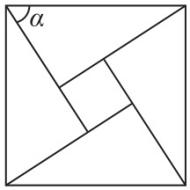
5.我国古代数学家赵爽在注解《周髀算经》一书时介绍了“赵爽弦图”,如图所示,它是由四个全等的直角三角形与一个小正方形拼成的大正方形,记直角三角形中较大的锐角为 $ \alpha $ ,大正方形的边长为 $ a $ ,小正方形的边长为 $ b $ ,若 $ \dfrac{ \sin \alpha (1-2 \sin \alpha \cos \alpha )}{ \sin \alpha - \cos \alpha }=\dfrac{2}{5} $ ,则 $ \dfrac{b}{a}= $ (      )
试题资源网 https://stzy.com

A. $ \dfrac{\sqrt{5}}{5} $

B. $ \dfrac{2\sqrt{5}}{5} $

C. $ \dfrac{1}{2} $

D. $ \dfrac{2}{3} $

答案:A
解析:

由题意可得 $ \dfrac{ \sin \alpha (1-2 \sin \alpha \cos \alpha )}{ \sin \alpha - \cos \alpha } $

$ =\dfrac{ \sin \alpha ({ \sin }^{2}\alpha +{ \cos }^{2}\alpha -2 \sin \alpha \cos \alpha )}{ \sin \alpha - \cos \alpha } $

$ =\dfrac{ \sin \alpha ( \sin \alpha - \cos \alpha )^{2}}{ \sin \alpha - \cos \alpha } $

$ = \sin \alpha ( \sin \alpha - \cos \alpha ) $

$ =\dfrac{{ \sin }^{2}\alpha - \sin \alpha \cos \alpha }{{ \sin }^{2}\alpha +{ \cos }^{2}\alpha } $

$ =\dfrac{{ \tan }^{2}\alpha - \tan \alpha }{{ \tan }^{2}\alpha +1}=\dfrac{2}{5} $ ,

解得 $ \tan \alpha =2 $ 或 $ \tan \alpha =-\dfrac{1}{3} $ (舍去).

因为 $ \alpha $ 是直角三角形中较大的锐角,所以 $ \dfrac{\mathrm{\pi }}{4} < \alpha < \dfrac{\mathrm{\pi }}{2} $ ,

所以 $ \cos \alpha =\dfrac{1}{\sqrt{1+{ \tan }^{2}\alpha }}=\dfrac{\sqrt{5}}{5} $ , $ \sin \alpha = \tan \alpha \cdot \cos \alpha =\dfrac{2\sqrt{5}}{5} $ .

易知直角三角形的两条直角边分别为 $ a \sin \alpha $ , $ a \cos \alpha $ ,则 $ b=a \sin \alpha -a \cos \alpha $ ,

所以 $ \dfrac{b}{a}= \sin \alpha - \cos \alpha =\dfrac{2\sqrt{5}}{5}-\dfrac{\sqrt{5}}{5}=\dfrac{\sqrt{5}}{5} $ .故选 $ \mathrm{A} $ .


6.(多选)已知 $ \sin \theta \cos \theta =\dfrac{3}{10} $ , $ | \sin \theta |=- \sin \theta $ ,则下列选项正确的有(      )(多选)

A. $ \dfrac{\theta }{2} $ 是第二象限角

B. $ \sin \theta + \cos \theta =-\dfrac{2\sqrt{10}}{5} $

C. $ \sin \theta - \cos \theta =\dfrac{\sqrt{10}}{5} $

D. $ \tan \theta =\dfrac{1}{3} $ 或3

答案:BD
解析:

对于 $ \mathrm{A} $ , $ \because | \sin \theta |=- \sin \theta $ , $ \sin \theta \cos \theta =\dfrac{3}{10} $ , $ \therefore \sin \theta < 0 $ , $ \cos \theta < 0 $ , $ \therefore \theta $ 为第三象限角, $ \therefore \mathrm{\pi }+2k\mathrm{\pi } < \theta < \dfrac{3\mathrm{\pi }}{2}+2k\mathrm{\pi }(k\in \boldsymbol{Z}) $ .

$ \therefore \dfrac{\mathrm{\pi }}{2}+k\mathrm{\pi } < \dfrac{\theta }{2} < \dfrac{3\mathrm{\pi }}{4}+k\mathrm{\pi }(k\in \boldsymbol{Z}) $ ,

当 $ k $ 为偶数时, $ \dfrac{\theta }{2} $ 为第二象限角;

当 $ k $ 为奇数时, $ \dfrac{\theta }{2} $ 为第四象限角, $ \therefore \dfrac{\theta }{2} $ 可能为第二或第四象限角,故 $ \mathrm{A} $ 错误.

对于 $ \mathrm{B} $ , $ ( \sin \theta + \cos \theta )^{2}=1+2 \sin \theta \cos \theta =\dfrac{8}{5} $ , $ \because \sin \theta < 0 $ , $ \cos \theta < 0 $ , $ \therefore \sin \theta + \cos \theta < 0 $ , $ \therefore \sin \theta + \cos \theta =-\dfrac{2\sqrt{10}}{5} $ ,故 $ \mathrm{B} $ 正确.

对于 $ \mathrm{C} $ , $ ( \sin \theta - \cos \theta )^{2}=1-2 \sin \theta \cos \theta =\dfrac{2}{5} $ , $ \because \sin \theta < 0 $ , $ \cos \theta < 0 $ , $ \therefore \sin \theta - \cos \theta $ 可能为正,也可能为负, $ \therefore \sin \theta - \cos \theta =±\dfrac{\sqrt{10}}{5} $ ,故 $ \mathrm{C} $ 错误.

对于 $ \mathrm{D} $ ,当 $ \sin \theta - \cos \theta =\dfrac{\sqrt{10}}{5} $ , $ \sin \theta + \cos \theta =-\dfrac{2\sqrt{10}}{5} $ 时, $ \sin \theta =-\dfrac{\sqrt{10}}{10} $ , $ \cos \theta =-\dfrac{3\sqrt{10}}{10} $ ,故 $ \tan \theta =\dfrac{1}{3} $ ;当 $ \sin \theta - \cos \theta =-\dfrac{\sqrt{10}}{5} $ , $ \sin \theta + \cos \theta =-\dfrac{2\sqrt{10}}{5} $ 时, $ \sin \theta =-\dfrac{3\sqrt{10}}{10} $ , $ \cos \theta =-\dfrac{\sqrt{10}}{10} $ ,故 $ \tan \theta =3 $ ,故 $ \tan \theta =\dfrac{1}{3} $ 或3,故 $ \mathrm{D} $ 正确.故选 $ \mathrm{B}\mathrm{D} $ .


7.已知 $ \sin \alpha =\dfrac{2m-5}{m+1} $ , $ \cos \alpha =-\dfrac{m}{m+1} $ ,且 $ \alpha $ 为第三象限角,则 $ \tan \alpha = $       .

答案:

$ \dfrac{4}{3} $

解析:

$ \because \sin \alpha =\dfrac{2m-5}{m+1} $ , $ \cos \alpha =-\dfrac{m}{m+1} $ , $ \therefore $ 由 $ { \sin }^{2}\alpha +{ \cos }^{2}\alpha =1 $ ,可得 $ {\left(\dfrac{2m-5}{m+1}\right) ^ {2}}+{\left(-\dfrac{m}{m+1}\right) ^ {2}}=1 $ ,解得 $ m=4 $ 或 $ m=\dfrac{3}{2} $ .

又 $ \because \alpha $ 为第三象限角, $ \therefore \sin \alpha < 0 $ , $ \cos \alpha < 0 $ ,

把 $ m $ 的值代入检验得 $ m=\dfrac{3}{2} $ ,

$ \therefore \sin \alpha =-\dfrac{4}{5} $ , $ \cos \alpha =-\dfrac{3}{5} $ ,可得 $ \tan \alpha =\dfrac{ \sin \alpha }{ \cos \alpha }=\dfrac{4}{3} $ .


8.若关于 $ x $ 的两个不等式 $ f(x) < 0 $ 和 $ g(x) < 0 $ 的解集分别为 $ (m,n) $ 和 $ (\dfrac{1}{n},\dfrac{1}{m}) $ ,则称这两个不等式为“对偶不等式”.已知 $ {x}^{2}-4 \cos \theta \cdot x+2 < 0 $ 与 $ a{x}^{2}-4\sqrt{3} \sin \theta \cdot x+1 < 0 $ 为“对偶不等式”,则 $ a $ , $ \theta $ 的值分别为                  .

答案:

2 $ k\mathrm{\pi }+\dfrac{\mathrm{\pi }}{6} $ , $ k\in \boldsymbol{Z} $

解析:

设 $ {x}^{2}-4 \cos \theta \cdot x+2 < 0 $ 的解集为 $ (m,n) $ , $ a{x}^{2}-4\sqrt{3} \sin \theta \cdot x+1 < 0 $ 的解集为 $ (\dfrac{1}{n},\dfrac{1}{m}) $ ,

则 $ \begin{cases}(4 \cos \theta )^{2}-8 > 0,\\ (4\sqrt{3} \sin \theta )^{2}-4a > 0,\\ m+n=4 \cos \theta ,\\ mn=2,\\ \dfrac{1}{n}+\dfrac{1}{m}=\dfrac{4\sqrt{3} \sin \theta }{a},\\ \dfrac{1}{nm}=\dfrac{1}{a},\end{cases} $ 所以 $ a=2 $ ,

所以 $ \dfrac{1}{n}+\dfrac{1}{m}=2\sqrt{3} \sin \theta =\dfrac{4 \cos \theta }{2}=\dfrac{m+n}{mn} $ ,

所以 $ \sqrt{3} \sin \theta = \cos \theta $ ,所以 $ \tan \theta =\dfrac{\sqrt{3}}{3} $ ,所以 $ \theta =k\mathrm{\pi }+\dfrac{\mathrm{\pi }}{6} $ , $ k\in \boldsymbol{Z} $ .


9.已知关于 $ x $ 的方程 $ 4{x}^{2}-2(\sqrt{3}+1)x+m=0 $ 的两个根分别为 $ \sin \theta $ 和 $ \cos \theta $ ,且 $ \theta \in (-2\mathrm{\pi },0) $ .

(1) 当 $ \tan \theta \ne 0 {\rm ,1} $ 时求 $ \dfrac{ \sin \theta }{1-\dfrac{1}{ \tan \theta }}+\dfrac{ \cos \theta }{1- \tan \theta } $ 的值;

(2) 求 $ m $ 的值;

(3) 求方程的两根及 $ \theta $ 的值.

答案:

(1) 【解】因为 $ \sin \theta $ 和 $ \cos \theta $ 是方程的两个根,所以 $ \begin{cases} \sin \theta + \cos \theta =\dfrac{\sqrt{3}+1}{2},\\ \sin \theta \cos \theta =\dfrac{m}{4},\\ 4(\sqrt{3}+1)^{2}-16m\geqslant 0.\end{cases} $

原式 $ =\dfrac{{ \sin }^{2}\theta }{ \sin \theta - \cos \theta }+\dfrac{{ \cos }^{2}\theta }{ \cos \theta - \sin \theta }=\dfrac{{ \sin }^{2}\theta -{ \cos }^{2}\theta }{ \sin \theta - \cos \theta }= \sin \theta + \cos \theta =\dfrac{\sqrt{3}+1}{2} $ .

(2) 【解】因为 $ \sin \theta + \cos \theta =\dfrac{\sqrt{3}+1}{2} $ ,所以 $ {\left( \sin \theta + \cos \theta \right) ^ {2}}=1+2 \sin \theta \cos \theta ={\left(\dfrac{\sqrt{3}+1}{2}\right) ^ {2}} $ ,

所以 $ 1+2×\dfrac{m}{4}={\left(\dfrac{\sqrt{3}+1}{2}\right) ^ {2}} $ ,解得 $ m=\sqrt{3} $ .

(3) 【解】由(2)可知, $ m=\sqrt{3} $ ,所以方程为 $ 4{x}^{2}-2(\sqrt{3}+1)x+\sqrt{3}=0 $ ,其两根为 $ {x}_{1}=\dfrac{\sqrt{3}}{2} $ , $ {x}_{2}=\dfrac{1}{2} $ ,

所以 $ \begin{cases} \sin \theta =\dfrac{\sqrt{3}}{2},\\ \cos \theta =\dfrac{1}{2}\end{cases} $ 或 $ \begin{cases} \sin \theta =\dfrac{1}{2},\\ \cos \theta =\dfrac{\sqrt{3}}{2}.\end{cases} $ 又因为 $ \theta \in (-2\mathrm{\pi },0) $ ,所以 $ \theta =-\dfrac{5\mathrm{\pi }}{3} $ 或 $ \theta =-\dfrac{11\mathrm{\pi }}{6} $ .

解析: