1.在 $ △ABC $ 中,内角 $ A $ , $ B $ , $ C $ 的对边分别为 $ a $ , $ b $ , $ c $ , $ △ABC $ 的面积为 $ S $ .若 $ a=1 $ , $ C=\dfrac{\mathrm{\pi }}{3} $ ,且 $ 2S= \cos B+b \cos A $ ,则 $ B= $ ( )
A. $ \dfrac{\mathrm{\pi }}{6} $
B. $ \dfrac{\mathrm{\pi }}{3} $
C. $ \dfrac{\mathrm{\pi }}{2} $
D. $ \dfrac{7\mathrm{\pi }}{12} $
因为 $ a=1 $ ,且 $ 2S= \cos B+b \cos A $ ,所以 $ 2S=a \cos B+b \cos A $ ,
即 $ 2×\dfrac{1}{2}ab \sin C=a \cos B+b \cos A $ ,
得 $ ab \sin C=a \cos B+b \cos A $ ,
由正弦定理得 $ a \sin B \sin C= \sin A \cos B+ \sin B \cos A= \sin (A+B) $ ,
在 $ △ABC $ 中, $ \sin C= \sin (A+B) $ , $ \sin C\ne 0 $ ,所以 $ a \sin B=1⇒ \sin B=\dfrac{1}{a}=1 $ .
因为 $ B\in (0,\mathrm{\pi }) $ ,所以 $ B=\dfrac{\mathrm{\pi }}{2} $ .故选 $ \mathrm{C} $ .
2.已知 $ a $ , $ b $ , $ c $ 分别是 $ △ABC $ 三内角 $ A $ , $ B $ , $ C $ 的对边,则“ $ a \sin C+a \cos C=b+c $ ”是“ $ △ABC $ 为直角三角形”的( )
A.充分不必要条件
B.必要不充分条件
C.充要条件
D.既不充分也不必要条件
在 $ △ABC $ 中,由 $ a \sin C+a \cos C=b+c $ 及正弦定理可得 $ \sin A \sin C+ \sin A \cos C= \sin B+ \sin C $ ,
由 $ A+C=\mathrm{\pi }-B $ ,可得 $ \sin A \sin C+ \sin A \cos C= \sin (A+C)+ \sin C $ ,
所以 $ \sin A \sin C= \cos A \sin C+ \sin C $ .
因为 $ C\in (0,\mathrm{\pi }) $ ,所以 $ \sin C > 0 $ ,即 $ \sin A= \cos A+1 $ ,所以 $ \sin A- \cos A=\sqrt{2} \sin (A-\dfrac{\mathrm{\pi }}{4})=1 $ ,则 $ \sin (A-\dfrac{\mathrm{\pi }}{4})=\dfrac{\sqrt{2}}{2} $ .
因为 $ A\in (0,\mathrm{\pi }) $ ,所以 $ A-\dfrac{\mathrm{\pi }}{4}\in (-\dfrac{\mathrm{\pi }}{4} $ , $ \dfrac{3\mathrm{\pi }}{4}) $ ,
所以 $ A-\dfrac{\mathrm{\pi }}{4}=\dfrac{\mathrm{\pi }}{4} $ ,即 $ A=\dfrac{\mathrm{\pi }}{2} $ ,所以 $ △ABC $ 为直角三角形,
故“ $ a \sin C+a \cos C=b+c $ ”是“ $ △ABC $ 为直角三角形”的充分条件.
若 $ △ABC $ 为直角三角形,设 $ C=\dfrac{\mathrm{\pi }}{2} $ , $ a=3 $ , $ b=4 $ , $ c=5 $ ,则 $ \sin C=1 $ , $ \cos C=0 $ ,所以 $ a \sin C+a \cos C=3 $ , $ b+c=9 $ ,
所以 $ a \sin C+a \cos C\ne b+c $ ,
所以“ $ a \sin C+a \cos C=b+c $ ”不是“ $ △ABC $ 为直角三角形”的必要条件.
综上,“ $ a \sin C+a \cos C=b+c $ ”是“ $ △ABC $ 为直角三角形”的充分不必要条件.故选 $ \mathrm{A} $ .
3.在 $ △ABC $ 中,内角 $ A $ , $ B $ , $ C $ 的对边分别为 $ a $ , $ b $ , $ c $ ,已知 $ △ABC $ 的面积为 $ 5\sqrt{3} $ , $ b=4 $ , $ \overrightarrow {BA}\cdot \overrightarrow {AC}=10 $ ,则 $ a= $ ( )
A. $ \sqrt{21} $
B. $ \sqrt{31} $
C. $ \sqrt{41} $
D. $ \sqrt{61} $
由 $ △ABC $ 的面积为 $ 5\sqrt{3} $ ,可得 $ 5\sqrt{3}=\dfrac{1}{2}bc \sin A $ ,
由 $ \overrightarrow {BA}\cdot \overrightarrow {AC}=10 $ ,可得 $ cb\mathrm{ \cos }(\mathrm{\pi }-A)=-bc\mathrm{ \cos }A=10 $ .因为 $ b=4 $ ,所以 $ c \sin A=\dfrac{5\sqrt{3}}{2} $ , $ c \cos A=-\dfrac{5}{2} $ ,
所以 $ \tan A=\dfrac{ \sin A}{ \cos A}=-\sqrt{3} $ .
因为 $ A\in (0,\mathrm{\pi }) $ ,所以 $ A=\dfrac{2\mathrm{\pi }}{3} $ ,所以 $ c=\dfrac{5\sqrt{3}}{2 \sin A}=\dfrac{5\sqrt{3}}{2×\dfrac{\sqrt{3}}{2}}=5 $ .
由余弦定理可知, $ {a}^{2}={b}^{2}+{c}^{2}-2bc \cos A={4}^{2}+{5}^{2}-2×4×5 \cos \dfrac{2\mathrm{\pi }}{3}=61 $ ,即 $ a=\sqrt{61} $ .故选 $ \mathrm{D} $ .
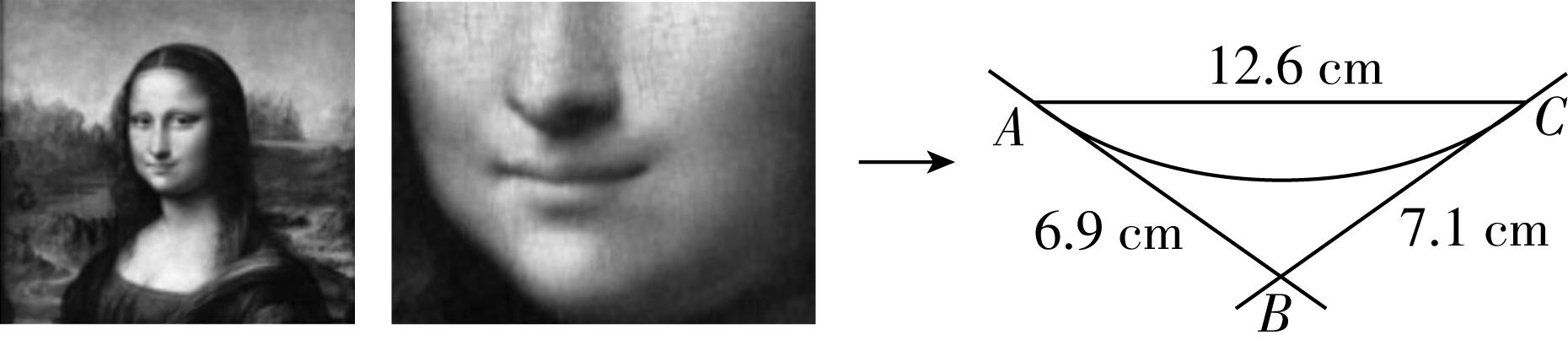
4.某艺术爱好者对《蒙娜丽莎》的同比例影像作品进行了测绘.将画中女子的嘴唇近似看作一个圆弧,在嘴角 $ A $ , $ C $ 处作圆弧的切线,两条切线交于 $ B $ 点,测得如下数据: $ AB=6.9\text{ }\mathrm{c}\mathrm{m} $ , $ BC=7.1\text{ }\mathrm{c}\mathrm{m} $ , $ AC=12.6\text{ }\mathrm{c}\mathrm{m} $ .根据测量得到的结果推算女子的嘴唇视作的圆弧对应的圆心角的范围为( )

A. $ (\dfrac{\mathrm{\pi }}{6},\dfrac{\mathrm{\pi }}{4}) $
B. $ (\dfrac{\mathrm{\pi }}{4},\dfrac{\mathrm{\pi }}{3}) $
C. $ (\dfrac{\mathrm{\pi }}{3},\dfrac{5\mathrm{\pi }}{12}) $
D. $ (\dfrac{5\mathrm{\pi }}{12},\dfrac{\mathrm{\pi }}{2}) $
根据余弦定理,得 $ \cos \mathrm{\angle }ABC=\dfrac{A{B}^{2}+B{C}^{2}-A{C}^{2}}{2AB\cdot BC}=\dfrac{{6.9}^{2}+{7.1}^{2}-{12.6}^{2}}{2×6.9×7.1}=\dfrac{-30.37}{48.99} $ ,所以 $ \dfrac{\mathrm{\pi }}{2} < \mathrm{\angle }ABC < \mathrm{\pi } $ .设 $ \stackrel{⌢}{AC} $ 对应的圆心角为 $ \alpha $ ,则有 $ \alpha +\mathrm{\angle }ABC=\mathrm{\pi } $ ,则 $ \cos \text{ }\alpha = \cos (\mathrm{\pi }-\mathrm{\angle }ABC)=- \cos \mathrm{\angle }ABC=\dfrac{30.37}{48.99} $ 且 $ 0 < \alpha < \dfrac{\mathrm{\pi }}{2} $ ,因为 $ \dfrac{1}{2} < \dfrac{30.37}{48.99} < \dfrac{\sqrt{2}}{2} $ ,所以 $ \alpha \in (\dfrac{\mathrm{\pi }}{4},\dfrac{\mathrm{\pi }}{3}) $ ,故选 $ \mathrm{B} $ .
5.我国南宋著名的数学家秦九韶在其著作《数书九章》中,提出了已知三角形三边长求三角形面积的公式,与著名的海伦公式完全等价,由此可以看出我国古代已具有很高的数学水平,其求法是:“以小斜幂并大斜幂减中斜幂,余半之,自乘于上.以小斜幂乘大斜幂减上,余四约之,为实.一为从隅,开平方得积.”若把以上这段文字写成公式,即 $ S=\sqrt{\dfrac{1}{4}[{c}^{2}{a}^{2}-{\left(\dfrac{{c}^{2}+{a}^{2}-{b}^{2}}{2}\right) ^ {2}}]} $ ,其中 $ a $ , $ b $ , $ c $ 分别为 $ △ABC $ 内角 $ A $ , $ B $ , $ C $ 的对边.若 $ \dfrac{1}{\sqrt{3} \sin B}=\dfrac{1}{ \tan B}+\dfrac{1}{ \tan C} $ , $ b=2\sqrt{2} $ ,则 $ △ABC $ 面积的最大值为( )
A.3
B. $ 2\sqrt{3} $
C. $ \sqrt{3} $
D. $ \sqrt{2} $
由 $ \dfrac{1}{\sqrt{3} \sin B}=\dfrac{1}{ \tan B}+\dfrac{1}{ \tan C} $ ,得 $ \dfrac{1}{\sqrt{3} \sin B}=\dfrac{ \cos B}{ \sin B}+\dfrac{ \cos C}{ \sin C} $ ,根据正弦定理及余弦定理,有 $ \dfrac{1}{\sqrt{3}b}=\dfrac{{a}^{2}+{c}^{2}-{b}^{2}}{2abc}+\dfrac{{a}^{2}+{b}^{2}-{c}^{2}}{2abc} $ ,整理得 $ c=\sqrt{3}a $ ,所以 $ △ABC $ 的面积 $ S=\sqrt{\dfrac{1}{4}[3{a}^{4}-{\left(\dfrac{4{a}^{2}-8}{2}\right) ^ {2}}]}=\dfrac{1}{2}\sqrt{-{\left({a}^{2}-8\right) ^ {2}}+48} $ ,
则易知当 $ a=2\sqrt{2} $ , $ c=2\sqrt{6} $ 时, $ S $ 取得最大值,为 $ 2\sqrt{3} $ .故选 $ \mathrm{B} $ .
6. $ △ABC $ 的内角 $ A $ , $ B $ , $ C $ 所对的边分别是 $ a $ , $ b $ , $ c $ .若 $ b=\sqrt{3} $ , $ {a}^{2}+{c}^{2}-ac={b}^{2} $ ,则 $ 2a+c $ 的最大值为( )
A. $ 2\sqrt{7} $
B. $ 2\sqrt{5} $
C. $ 5+\sqrt{3} $
D. $ 5-\sqrt{3} $
由已知及余弦定理得 $ \cos B=\dfrac{{a}^{2}+{c}^{2}-{b}^{2}}{2ac}=\dfrac{ac}{2ac}=\dfrac{1}{2} $ ,又 $ 0 < B < \mathrm{\pi } $ ,故 $ B=\dfrac{\mathrm{\pi }}{3} $ .
由正弦定理知, $ \dfrac{b}{ \sin B}=\dfrac{a}{ \sin A}=\dfrac{c}{ \sin C}=2 $ ,则 $ a=2 \sin A $ , $ c=2 \sin C $ ,
所以 $ 2a+c=4 \sin A+2 \sin C=4 \sin (\dfrac{2\mathrm{\pi }}{3}-C)+2 \sin C=4 \sin C+2\sqrt{3} \cos C=2\sqrt{7} \sin (C+\varphi ) $ ,其中 $ \tan \varphi =\dfrac{\sqrt{3}}{2} $ 且 $ \varphi \in (0,\dfrac{\mathrm{\pi }}{2}) $ .因为 $ \tan \varphi =\dfrac{\sqrt{3}}{2}\in (\dfrac{\sqrt{3}}{3},1) $ ,所以 $ \varphi \in (\dfrac{\mathrm{\pi }}{6},\dfrac{\mathrm{\pi }}{4}) $ ,
又 $ 0 < C < \dfrac{2\mathrm{\pi }}{3} $ ,所以 $ \dfrac{\mathrm{\pi }}{6} < C+\varphi < \dfrac{11\mathrm{\pi }}{12} $ ,所以当 $ C+\varphi =\dfrac{\mathrm{\pi }}{2} $ 时, $ 2a+c $ 取得最大值,为 $ 2\sqrt{7} $ .故选 $ \mathrm{A} $ .
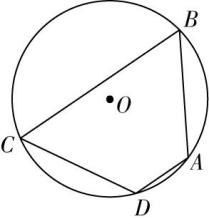
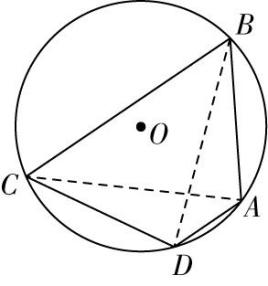
7.(多选)四边形 $ ABCD $ 内接于圆 $ O $ , $ AB=CD=5 $ , $ AD=3 $ , $ \mathrm{\angle }BCD={60}^{\circ } $ ,如图所示,下列结论正确的有( )
(多选)
A.四边形 $ ABCD $ 为梯形
B.四边形 $ ABCD $ 的面积为 $ \dfrac{55\sqrt{3}}{4} $
C.圆 $ O $ 的直径为7
D. $ △ABD $ 的三边长度满足 $ AD+BD=2AB $
对于 $ \mathrm{A} $ , $ \because \mathrm{\angle }BCD={60}^{\circ } $ , $ \therefore \mathrm{\angle }BAD={120}^{\circ } $ ,
连接 $ AC $ , $ BD $ ,由 $ AB=CD $ 可得 $ \mathrm{\angle }BDA=\mathrm{\angle }CAD $ , $ \because \mathrm{\angle }ABD=\mathrm{\angle }ACD $ ,

$ \therefore △BAD≌△CDA(\mathrm{A}\mathrm{A}\mathrm{S}) $ ,
$ \therefore \mathrm{\angle }BAD=\mathrm{\angle }CDA={120}^{\circ } $ ,
$ \therefore \mathrm{\angle }BCD+\mathrm{\angle }CDA={180}^{\circ } $ , $ \therefore BC//DA $ ,
显然 $ AB $ 不平行于 $ CD $ ,则四边形 $ ABCD $ 为梯形,故 $ \mathrm{A} $ 正确;
对于 $ \mathrm{B} $ ,在 $ △ABD $ 中,由余弦定理得 $ B{D}^{2}=A{B}^{2}+A{D}^{2}-2AB\cdot AD \cos \mathrm{\angle }BAD={5}^{2}+{3}^{2}-2×5×3×(-\dfrac{1}{2})=49 $ ,
在 $ △BCD $ 中,由余弦定理可得 $ B{D}^{2}=C{B}^{2}+C{D}^{2}-2CB\cdot CD \cos \mathrm{\angle }BCD $ ,
即 $ 49=C{B}^{2}+{5}^{2}-2×CB×5 \cos {60}^{\circ } $ ,解得 $ CB=8 $ 或 $ CB=-3 $ (舍去),
$ \therefore {S}_{△BCD}=\dfrac{1}{2}CB\cdot CD \sin {60}^{\circ }=\dfrac{1}{2}×8×5×\dfrac{\sqrt{3}}{2}=10\sqrt{3} $ ,又 $ {S}_{△ABD}=\dfrac{1}{2}AB\cdot AD \sin {120}^{\circ }=\dfrac{1}{2}×5×3×\dfrac{\sqrt{3}}{2}=\dfrac{15\sqrt{3}}{4} $ , $ \therefore {S}_{四边形ABCD}={S}_{△BCD}+{S}_{△ABD}=10\sqrt{3}+\dfrac{15\sqrt{3}}{4}=\dfrac{55\sqrt{3}}{4} $ ,故 $ \mathrm{B} $ 正确;
对于 $ \mathrm{C} $ ,由 $ \mathrm{B} $ 可知, $ CB=8 $ ,则圆 $ O $ 的直径不可能是7,故 $ \mathrm{C} $ 错误;
对于 $ \mathrm{D} $ ,在 $ △ABD $ 中, $ AD=3 $ , $ AB=5 $ , $ BD=7 $ ,满足 $ AD+BD=2AB $ ,故 $ \mathrm{D} $ 正确.
故选 $ \mathrm{A}\mathrm{B}\mathrm{D} $ .
8.如图,一滑轮组中有两个定滑轮 $ A $ , $ B $ ,在从连接点 $ O $ 出发的三根绳的端点处挂着三个重物,它们所受的重力分别为 $ 4\mathrm{N} $ , $ 4\mathrm{N} $ , $ 7\mathrm{N} $ ,此时整个系统处于平衡状态,则 $ \cos \mathrm{\angle }AOB= $ .

$ \dfrac{17}{32} $
依题意, $ |\overrightarrow {OA}|=|\overrightarrow {OB}|=4 $ , $ |\overrightarrow {OA}+\overrightarrow {OB}|=7 $ ,则 $ {\overrightarrow {OA}}^{2}+2\overrightarrow {OA}\cdot \overrightarrow {OB}+{\overrightarrow {OB}}^{2}=49 $ ,即 $ 16+2\overrightarrow {OA}\cdot \overrightarrow {OB}+16=49 $ ,解得 $ \overrightarrow {OA}\cdot \overrightarrow {OB}=\dfrac{17}{2} $ ,所以 $ \cos \mathrm{\angle }AOB=\dfrac{\overrightarrow {OA}\cdot \overrightarrow {OB}}{|\overrightarrow {OA}||\overrightarrow {OB}|}=\dfrac{17}{32} $ .
9.已知 $ △ABC $ 中,内角 $ A $ , $ B $ , $ C $ 的对边分别为 $ a $ , $ b $ , $ c $ ,且满足 $ (2\overrightarrow {AB}+\overrightarrow {AC})\perp \overrightarrow {BC} $ , $ \overrightarrow {BA} $ 在 $ \overrightarrow {BC} $ 上的投影向量的模为 $ \dfrac{\sqrt{3}}{3}c $ ,则 $ A= $ .
$ \dfrac{\mathrm{\pi }}{2} $
由 $ (2\overrightarrow {AB}+\overrightarrow {AC})\perp \overrightarrow {BC} $ ,得 $ 2\overrightarrow {AB}\cdot \overrightarrow {BC}+\overrightarrow {AC}\cdot \overrightarrow {BC}=0 $ ,故 $ -2ac \cos B+ba \cos C=0 $ .
又 $ B $ , $ C $ 都为三角形的内角,所以 $ \cos B > 0 $ , $ \cos C > 0 $ .

由 $ \overrightarrow {BA} $ 在 $ \overrightarrow {BC} $ 上的投影向量的模为 $ \dfrac{\sqrt{3}}{3}c $ 可得 $ |\overrightarrow {BA}| \cos B=\dfrac{\sqrt{3}}{3}c $ ,即 $ c \cos B=\dfrac{\sqrt{3}}{3}c $ ,故 $ \cos B=\dfrac{\sqrt{3}}{3} $ .
所以 $ b \cos C=2c \cos B=\dfrac{2\sqrt{3}}{3}c $ ,
所以 $ a=c \cos B+b \cos C=\dfrac{\sqrt{3}}{3}c+\dfrac{2\sqrt{3}}{3}c=\sqrt{3}c $ .
由余弦定理可知, $ {b}^{2}={a}^{2}+{c}^{2}-2ac\cdot \dfrac{\sqrt{3}}{3}=3{c}^{2}+{c}^{2}-2\sqrt{3}{c}^{2}×\dfrac{\sqrt{3}}{3}=4{c}^{2}-2{c}^{2}=2{c}^{2} $ ,
所以 $ b=\sqrt{2}c $ ,
所以 $ \cos A=\dfrac{{b}^{2}+{c}^{2}-{a}^{2}}{2bc}=\dfrac{2{c}^{2}+{c}^{2}-3{c}^{2}}{2bc}=0 $ ,又 $ A\in (0,\mathrm{\pi }) $ ,故 $ A=\dfrac{\mathrm{\pi }}{2} $ .
10.如图,在 $ △ABC $ 中, $ A={90}^{\circ } $ , $ AB=AC=6 $ , $ M $ , $ N $ 为 $ AB $ 的三等分点 $ (M $ 靠近点 $ A) $ , $ P $ 为 $ BC $ 边上的动点.

① 当 $ \dfrac{BP}{BC}=\dfrac{1}{3} $ 时, $ \overrightarrow {PM}\cdot \overrightarrow {PN}= $ ;
② $ \overrightarrow {PM}\cdot \overrightarrow {PN} $ 的最小值为 .
① 4
② $ \dfrac{7}{2} $
10.以 $ A $ 为坐标原点建立平面直角坐标系,如图所示.

设 $ P(x,y) $ ,易知 $ M(2,0) $ , $ N(4,0) $ .
① 由 $ \dfrac{BP}{BC}=\dfrac{1}{3} $ 可得 $ \dfrac{y}{6}=\dfrac{6-x}{6}=\dfrac{1}{3} $ ,即 $ P(4,2) $ ,
因此 $ \overrightarrow {PM}\cdot \overrightarrow {PN}=(-2,-2)\cdot (0,-2)=4 $ .
② 因为 $ P $ 为 $ BC $ 边上的动点,所以 $ x+y=6 $ ,且 $ x\in [0,6] $ ,
则 $ \overrightarrow {PM}\cdot \overrightarrow {PN}= (2-x,-y )\cdot (4-x,-y )={x}^{2}-6x+8+{y}^{2}={x}^{2}-6x+8+ (6-x)^{2}=2{x}^{2}-18x+44=2{\left(x-\dfrac{9}{2} \right) ^ {2}}+\dfrac{7}{2} $ ,故当 $ x=\dfrac{9}{2} $ 时, $ \overrightarrow {PM}\cdot \overrightarrow {PN} $ 取得最小值,最小值为 $ \dfrac{7}{2} $ .
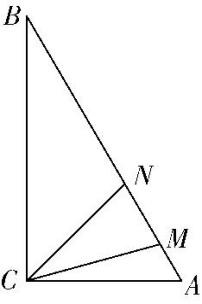
11.为响应国家“乡村振兴”号召,农民老王拟将自家一块直角三角形地按如图规划成3个功能区: $ △BNC $ 区域规划为荔枝林, $ △CMA $ 区域规划为供游客住宿及餐饮的民宿, $ △MNC $ 区域规划为供休闲垂钓的小型鱼塘.为安全起见,在鱼塘 $ △MNC $ 周围筑起护栏.已知 $ AC=40\mathrm{m} $ , $ BC=40\sqrt{3}\mathrm{m} $ , $ AC\perp BC $ , $ \mathrm{\angle }MCN={30}^{\circ } $ .

(1) 若鱼塘 $ △MNC $ 的面积是民宿 $ △CMA $ 的面积的 $ \sqrt{3} $ 倍,求 $ \mathrm{\angle }ACM $ .
(2) 当 $ \mathrm{\angle }ACM $ 为何值时,鱼塘 $ △MNC $ 的面积最小,最小面积是多少?
(1) 【解】设 $ \mathrm{\angle }ACM=\theta ({0}^{\circ } < \theta < {60}^{\circ }) $ ,则 $ \mathrm{\angle }BCN={60}^{\circ }-\theta $ ,
在 $ △ABC $ 中, $ AC\perp BC $ , $ AC=40 $ , $ BC=40\sqrt{3} $ ,则 $ A={60}^{\circ } $ , $ B={30}^{\circ } $ .
因为鱼塘 $ △MNC $ 的面积是民宿 $ △CMA $ 的面积的 $ \sqrt{3} $ 倍,
所以 $ \dfrac{1}{2}CN\cdot CM \sin {30}^{\circ }=\sqrt{3}\cdot \dfrac{1}{2}AC\cdot CM \sin \theta $ ,即 $ CN=80\sqrt{3} \sin \theta $ .
在 $ △CAN $ 中, $ \mathrm{\angle }CNA=B+\mathrm{\angle }BCN={90}^{\circ }-\theta $ ,由正弦定理可得 $ \dfrac{CN}{ \sin A}=\dfrac{AC}{ \sin \mathrm{\angle }CNA} $ ,即 $ \dfrac{CN}{ \sin {60}^{\circ }}=\dfrac{AC}{ \sin ({90}^{\circ }-\theta )}=\dfrac{40}{ \cos \theta } $ ,则 $ CN=\dfrac{20\sqrt{3}}{ \cos \theta } $ ,则 $ 80\sqrt{3} \sin \theta =\dfrac{20\sqrt{3}}{ \cos \theta } $ ,即 $ \sin 2\theta =\dfrac{1}{2} $ .
由 $ {0}^{\circ } < 2\theta < {120}^{\circ } $ ,得 $ 2\theta ={30}^{\circ } $ ,
所以 $ \theta ={15}^{\circ } $ ,即 $ \mathrm{\angle }ACM={15}^{\circ } $ .
(2) 由(1)知 $ \mathrm{\angle }ACM=\theta ({0}^{\circ } < \theta < {60}^{\circ }) $ , $ B={30}^{\circ } $ , $ A={60}^{\circ } $ ,所以 $ AB=2AC=80 $ ,
在 $ △ACM $ 中,由正弦定理得 $ \dfrac{CM}{ \sin A}=\dfrac{AC}{ \sin \mathrm{\angle }AMC} $ ,即 $ \dfrac{CM}{ \sin {60}^{\circ }}=\dfrac{AC}{ \sin ({120}^{\circ }-\theta )} $ ,则 $ CM=\dfrac{20\sqrt{3}}{ \sin ({120}^{\circ }-\theta )} $ ,由(1)知 $ CN=\dfrac{20\sqrt{3}}{ \cos \theta } $ ,
所以 $ {S}_{△CMN}=\dfrac{1}{2}CM\cdot CN\cdot \sin {30}^{\circ } $
$ =\dfrac{300}{ \sin ({120}^{\circ }-\theta ) \cos \theta } $
$ =\dfrac{300}{\dfrac{1}{2} \sin \theta \cos \theta +\dfrac{\sqrt{3}}{2}{ \cos }^{2}\theta } $
$ =\dfrac{600}{\dfrac{ \sin 2\theta }{2}+\dfrac{\sqrt{3} \cos 2\theta }{2}+\dfrac{\sqrt{3}}{2}} $
$ =\dfrac{1200}{2 \sin (2\theta +{60}^{\circ })+\sqrt{3}} $ .
又 $ {0}^{\circ } < \theta < {60}^{\circ } $ ,所以 $ {60}^{\circ } < 2\theta +{60}^{\circ } < {180}^{\circ } $ ,所以当且仅当 $ 2\theta +{60}^{\circ }={90}^{\circ } $ ,即 $ \theta ={15}^{\circ } $ 时,
$ △CMN $ 的面积取最小值,为 $ \dfrac{1200}{2+\sqrt{3}}=1200(2-\sqrt{3}){\mathrm{m}}^{2} $ .
12.在 $ △ABC $ 中,内角 $ A $ , $ B $ , $ C $ 所对应的边分别为 $ a $ , $ b $ , $ c $ .已知 $ (2a \cos C+2c \cos A) \cos A=b $ .

(1) 求角 $ A $ ;
(2) 若 $ a=2 $ , $ \overrightarrow {AC}\cdot \overrightarrow {AB}=2 $ ,求 $ △ABC $ 的周长;
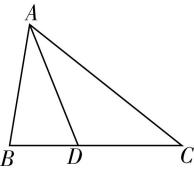
(3) 如图, $ \mathrm{\angle }BAC $ 的平分线 $ AD $ 交 $ BC $ 于点 $ D $ , $ AD=2 $ ,求 $ \dfrac{1}{BD}+\dfrac{1}{CD} $ 的取值范围.
(1) 【解】 $ \because (2a \cos C+2c \cos A) \cos A=b $ ,
$ \therefore $ 由正弦定理可得 $ (2 \sin A \cos C+2 \sin C\cdot \cos A) \cos A= \sin B $ ,
在 $ △ABC $ 中, $ B=\mathrm{\pi }-(A+C) $ ,则 $ \sin B= \sin (A+C)= \sin A \cos C+ \cos A \sin C $ ,
原式化简得 $ 2 \sin B \cos A= \sin B $ .
$ \because \sin B > 0 $ , $ \therefore \cos A=\dfrac{1}{2} $ .
又 $ \because A\in (0,\mathrm{\pi }) $ , $ \therefore A=\dfrac{\mathrm{\pi }}{3} $ .
(2) 在 $ △ABC $ 中, $ A=\dfrac{\mathrm{\pi }}{3} $ ,则 $ \overrightarrow {AB}\cdot \overrightarrow {AC}=cb \cos A=\dfrac{1}{2}bc=2 $ ,得 $ bc=4 $ .
由余弦定理得 $ {a}^{2}={b}^{2}+{c}^{2}-2bc \cos A $ ,得 $ {b}^{2}+{c}^{2}=bc+4 $ ,
配方得 $ (b+c)^{2}=4+3bc $ ,于是 $ (b+c)^{2}=16 $ ,得 $ b+c=4 $ , $ \therefore a+b+c=6 $ ,
故 $ △ABC $ 的周长为6.
(3) 在 $ △ABD $ 中,由正弦定理可得 $ \dfrac{AD}{ \sin B}=\dfrac{BD}{ \sin \mathrm{\angle }BAD} $ ,
$ \therefore \dfrac{1}{BD}=\dfrac{ \sin B}{AD \sin \dfrac{\mathrm{\pi }}{6}}= \sin B $ ,同理可得, $ \dfrac{1}{CD}= \sin C $ .
$ \therefore \dfrac{1}{BD}+\dfrac{1}{CD}= \sin B+ \sin C $ .
由(1)知 $ A=\dfrac{\mathrm{\pi }}{3} $ ,则 $ B+C=\dfrac{2\mathrm{\pi }}{3} $ ,
$ \therefore \dfrac{1}{BD}+\dfrac{1}{CD}= \sin B+ \sin (B+\dfrac{\mathrm{\pi }}{3})= \sin B+\dfrac{1}{2} \sin B+\dfrac{\sqrt{3}}{2} \cos B=\dfrac{3}{2} \sin B+\dfrac{\sqrt{3}}{2} \cos B=\sqrt{3} \sin (B+\dfrac{\mathrm{\pi }}{6}) $ .
$ \because B\in (0,\dfrac{2\mathrm{\pi }}{3}) $ , $ \therefore B+\dfrac{\mathrm{\pi }}{6}\in (\dfrac{\mathrm{\pi }}{6},\dfrac{5\mathrm{\pi }}{6}) $ .
$ \therefore \sin (B+\dfrac{\mathrm{\pi }}{6})\in (\dfrac{1}{2},1] $ ,
$ \therefore \dfrac{1}{BD}+\dfrac{1}{CD}\in (\dfrac{\sqrt{3}}{2},\sqrt{3}] $ .
因此, $ \dfrac{1}{BD}+\dfrac{1}{CD} $ 的取值范围为 $ (\dfrac{\sqrt{3}}{2},\sqrt{3}] $ .
13.在 $ △ABC $ 中, $ \mathrm{\angle }BAC={60}^{\circ } $ , $ \mathrm{\angle }BAP=\mathrm{\angle }CAP $ , $ P $ 在 $ △ABC $ 内部,延长 $ BP $ 交 $ AC $ 于 $ Q $ ,且 $ \dfrac{1}{BP}+\dfrac{1}{CP}=\dfrac{1}{PQ} $ ,则 $ \mathrm{\angle }BPC= $ ( )
A. $ {140}^{\circ } $
B. $ {130}^{\circ } $
C. $ {110}^{\circ } $
D. $ {120}^{\circ } $
如图.

由题可知, $ AP $ 为 $ \mathrm{\angle }BAC $ 的平分线,故 $ \dfrac{PQ}{BP}=\dfrac{AQ}{AB}=\dfrac{ \sin \mathrm{\angle }ABQ}{ \sin \mathrm{\angle }AQB} $ .在 $ △PQC $ 中, $ \dfrac{PQ}{CP}=\dfrac{ \sin \mathrm{\angle }PCQ}{ \sin \mathrm{\angle }PQC} $ .
由 $ \dfrac{1}{BP}+\dfrac{1}{CP}=\dfrac{1}{PQ} $ ,可得 $ \dfrac{PQ}{BP}+\dfrac{PQ}{CP}=1 $ ,
于是 $ \dfrac{PQ}{BP}+\dfrac{PQ}{CP}=\dfrac{ \sin \mathrm{\angle }ABQ}{ \sin \mathrm{\angle }AQB}+\dfrac{ \sin \mathrm{\angle }PCQ}{ \sin \mathrm{\angle }PQC}=\dfrac{ \sin \mathrm{\angle }ABQ+ \sin \mathrm{\angle }PCQ}{ \sin \mathrm{\angle }PQC}=\dfrac{ \sin \mathrm{\angle }ABQ+ \sin \mathrm{\angle }PCQ}{ \sin ({60}^{\circ }+\mathrm{\angle }ABQ)}=1 $ ,
即 $ \sin \mathrm{\angle }ABQ+ \sin \mathrm{\angle }PCQ= \sin ({60}^{\circ }+\mathrm{\angle }ABQ) $ ,
化简可得 $ \sin \mathrm{\angle }PCQ= \sin ({60}^{\circ }-\mathrm{\angle }ABQ) $ ,因为 $ {0}^{\circ } < \mathrm{\angle }PCQ < {120}^{\circ } $ , $ -{60}^{\circ } < {60}^{\circ }-\mathrm{\angle }ABQ < {60}^{\circ } $ ,
所以 $ \mathrm{\angle }PCQ={60}^{\circ }-\mathrm{\angle }ABQ $ ,
故 $ \mathrm{\angle }BPC=\mathrm{\angle }PQC+\mathrm{\angle }PCQ=\mathrm{\angle }ABQ+\mathrm{\angle }BAC+\mathrm{\angle }PCQ={120}^{\circ } $ .故选 $ \mathrm{D} $ .
14.已知 $ △ABC $ 的内角 $ A $ , $ B $ , $ C $ 所对的边分别为 $ a $ , $ b $ , $ c $ ,满足 $ {a}^{2}+{b}^{2}+{c}^{2}=\alpha $ , $ {a}^{2}{b}^{2}+{b}^{2}{c}^{2}+{c}^{2}{a}^{2}=\beta $ ,则 $ △ABC $ 的面积为 .
$ \dfrac{1}{2}\sqrt{\beta -\dfrac{{\alpha }^{2}}{4}} $
由题意可知 $ {S}_{△ABC}=\dfrac{1}{2}ab \sin C=\dfrac{1}{2}ab\sqrt{1-{ \cos }^{2}C} $
$ =\dfrac{1}{2}ab\sqrt{1-\dfrac{({a}^{2}+{b}^{2}-{c}^{2})^{2}}{4{a}^{2}{b}^{2}}} $
$ =\dfrac{1}{2}\sqrt{{a}^{2}{b}^{2}-\dfrac{({a}^{2}+{b}^{2}-{c}^{2})^{2}}{4}} $ ,
因为 $ {a}^{2}+{b}^{2}+{c}^{2}=\alpha $ ,所以 $ {a}^{2}+{b}^{2}=\alpha -{c}^{2} $ .
因为 $ {a}^{2}{b}^{2}+{b}^{2}{c}^{2}+{c}^{2}{a}^{2}=\beta $ ,所以 $ {a}^{2}{b}^{2}+{c}^{2}(\alpha -{c}^{2})=\beta ⇒{a}^{2}{b}^{2}=\beta -{c}^{2}(\alpha -{c}^{2}) $ ,
此时 $ {S}_{△ABC}=\dfrac{1}{2}\sqrt{\beta -{c}^{2} (\alpha -{c}^{2} )-\dfrac{ (\alpha -2{c}^{2})^{2}}{4}}=\dfrac{1}{2}\sqrt{\beta -\dfrac{{\alpha }^{2}}{4}} $ .
15.已知 $ △ABC $ 的内角 $ A $ , $ B $ , $ C $ 的对边分别为 $ a $ , $ b $ , $ c $ , $ \cos B \cos A= \sin B(1+ \sin A) $ ,求 $ \dfrac{b \sin A+a \sin B}{b \cos B} $ 的取值范围.
【解】由 $ \cos B \cos A= \sin B(1+ \sin A) $ 得
$ \cos B \cos A- \sin A \sin B= \cos (A+B)= \sin B $ ,
又 $ C=\mathrm{\pi }-A-B $ ,所以 $ - \cos C= \sin B $ .
因为 $ - \cos C= \sin (C-\dfrac{\mathrm{\pi }}{2})= \sin B $ , $ C-\dfrac{\mathrm{\pi }}{2}\in (-\dfrac{\mathrm{\pi }}{2},\dfrac{\mathrm{\pi }}{2}) $ , $ B\in (0,\mathrm{\pi }) $ ,所以 $ C-\dfrac{\mathrm{\pi }}{2}=B $ 或 $ B+C-\dfrac{\mathrm{\pi }}{2}=\mathrm{\pi } $ (舍去).
则 $ C=B+\dfrac{\mathrm{\pi }}{2} $ ,则 $ A=\mathrm{\pi }-B-C=\dfrac{\mathrm{\pi }}{2}-2B > 0 $ ,则 $ B\in (0,\dfrac{\mathrm{\pi }}{4}) $ .
从而 $ \dfrac{b \sin A+a \sin B}{b \cos B}=\dfrac{ \sin B \sin A+ \sin A \sin B}{ \sin B \cos B}= $
$ \dfrac{2 \sin A}{ \cos B}=\dfrac{2 \sin (\dfrac{\mathrm{\pi }}{2}-2B)}{ \cos B}=\dfrac{2 \cos 2B}{ \cos B}=2\cdot \dfrac{2{ \cos }^{2}B-1}{ \cos B}=4 \cos B-\dfrac{2}{ \cos B} $ ,
由 $ y= \cos x $ 在 $ (0,\dfrac{\mathrm{\pi }}{4}) $ 上单调递减,故 $ f(x)=4 \cos x-\dfrac{2}{ \cos x} $ 在 $ (0,\dfrac{\mathrm{\pi }}{4}) $ 上单调递减,
因此 $ f(\dfrac{\mathrm{\pi }}{4}) < f(x) < f(0) $ ,即 $ 0 < f(x) < 2 $ ,所以 $ \dfrac{b \sin A+a \sin B}{b \cos B} $ 的取值范围为 $ (0,2) $ .