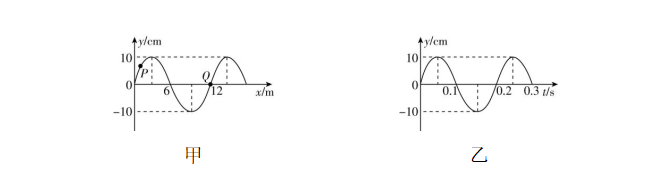
1.如图甲所示是一列简谐横波在 $ t=0.1\mathrm{s} $ 时刻的波形图, $ P $ 是平衡位置在 $ x=1.5\mathrm{m} $ 处的质点, $ Q $ 是平衡位置在 $ x=12\mathrm{m} $ 处的质点;图乙为质点 $ Q $ 的振动图像,下列说法正确的是( )
A.这列波沿 $ x $ 轴负方向传播
B.在 $ t=0.35\mathrm{s} $ 时,质点 $ Q $ 的位置坐标为 $ (12\mathrm{m},10\mathrm{c}\mathrm{m}) $
C.从 $ t=0.1\mathrm{s} $ 到 $ t=0.35\mathrm{s} $ 的过程中,质点 $ P $ 的路程为 $ 50\mathrm{c}\mathrm{m} $
D.从 $ t=0.1\mathrm{s} $ 时刻开始计时,质点 $ P $ 再过 $ \mathrm{\Delta }t=(0.075+0.2n)\mathrm{s}(n=0,1,2,\cdots ) $ 时到达波谷
根据质点 $ Q $ 的振动图像,可知在 $ t=0.1\mathrm{s} $ 时,质点 $ Q $ 的振动方向沿 $ y $ 轴负方向,由波形图结合“同侧法”可知这列波沿 $ x $ 轴正方向传播,故 $ \mathrm{A} $ 错误;由振动图像可知,质点 $ Q $ 的振动周期 $ T=0.2\mathrm{s} $ ,由于 $ \mathrm{\Delta }t=0.35\mathrm{s}-0.1\mathrm{s}=0.25\mathrm{s}=1\dfrac{1}{4}T $ ,可知, $ t=0.35\mathrm{s} $ 时质点 $ Q $ 恰好位于波谷,质点 $ Q $ 位置坐标为 $ (12\mathrm{m},-10\mathrm{c}\mathrm{m}) $ ,故 $ \mathrm{B} $ 错误;根据 $ \mathrm{B} $ 选项分析可知,从 $ t=0.1\mathrm{s} $ 到 $ t=0.35\mathrm{s} $ 的过程中,质点 $ P $ 振动了 $ 1\dfrac{1}{4}T $ ,在一个周期的时间内,其路程为 $ 4A=40\mathrm{c}\mathrm{m} $ ,在 $ \dfrac{1}{4}T $ 时间内,质点 $ P $ 先向平衡位置振动,再远离平衡位置振动,平均速率大于一个周期内的平均速率,所以其路程大于 $ A=10\mathrm{c}\mathrm{m} $ ,可知从 $ t=0.1\mathrm{s} $ 到 $ t=0.35\mathrm{s} $ 的过程中质点 $ P $ 的路程大于 $ 50\mathrm{c}\mathrm{m} $ ,故 $ \mathrm{C} $ 错误;由波形图可知,该波的波长 $ \lambda =12\mathrm{m} $ ,故波速 $ v=\dfrac{\lambda }{T}=60\mathrm{m}/\mathrm{s} $ ,波沿 $ x $ 轴正方向传播,由波形图可知 $ P $ 点左侧的第一个波谷向 $ x $ 轴正方向传播 $ x=\dfrac{1}{4}\lambda +1.5\mathrm{m}=4.5\mathrm{m} $ 时,质点 $ P $ 第一次到达波谷,则质点 $ P $ 第一次到达波谷所用时间 $ t=\dfrac{x}{v}=0.075\mathrm{s} $ ,结合波传播的周期性可知质点 $ P $ 在 $ \mathrm{\Delta }t=(0.075+0.2n)\mathrm{s}(n=0,1,2,\cdots ) $ 时到达波谷,故 $ \mathrm{D} $ 正确.
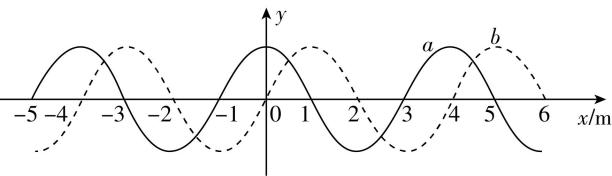
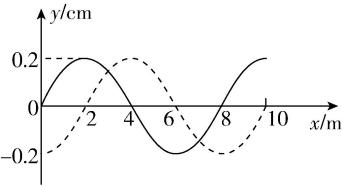
2.正弦波因其数学简洁性、物理可实现性及能量集中特性,成为自然界和工程技术中最基础的“通用语言”.图中的 $ a $ 是一列正弦波在某时刻的波形曲线, $ b $ 是 $ 0.2\mathrm{s} $ 后它的波形曲线.

(1) 若该波的周期 $ T $ 大于 $ 0.2\mathrm{s} $ ,且向右传播,求波的传播速度和周期;
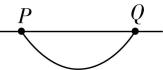
(2) 若该波向左传播,求波的传播速度和周期.
(1) $ 5\mathrm{m}/\mathrm{s} $ ; $ 0.8\mathrm{s} $
(2) $ 5(4n+3)\mathrm{m}/\mathrm{s}(n=0,1,2,3,\cdots ) $ ; $ \dfrac{4}{5(4n+3)}\mathrm{s}(n=0,1,2,3,\cdots ) $
(1) 由题图可知,波长 $ \lambda =4\mathrm{m} $ ,波向右传播,则有 $ v\cdot \mathrm{\Delta }t=\dfrac{1}{4}\lambda +n\lambda (n=0,1,2,3,\cdots ) $ ,解得 $ v=5(4n+1)\mathrm{m}/\mathrm{s}(n=0,1,2,3,\cdots ) $ ,由 $ T=\dfrac{\lambda }{v} $ ,解得 $ T=\dfrac{4}{5(4n+1)}\mathrm{s}(n=0,1,2,3,\cdots ) $ ,又 $ T > 0.2\mathrm{s} $ ,则 $ n=0 $ ,代入解得 $ v=5\mathrm{m}/\mathrm{s} $ , $ T=0.8\mathrm{s} $ .
(2) 若该波向左传播,则有 $ v^\prime \cdot \mathrm{\Delta }t=\dfrac{3}{4}\lambda +n\lambda (n=0,1,2,3,\cdots ) $ ,由 $ T^\prime =\dfrac{\lambda }{v^\prime } $ ,解得 $ v^\prime =5(4n+3)\mathrm{m}/\mathrm{s}(n=0,1,2,3,\cdots ) $ , $ T^\prime =\dfrac{4}{5(4n+3)}\mathrm{s}(n=0,1,2,3,\cdots ) $ .
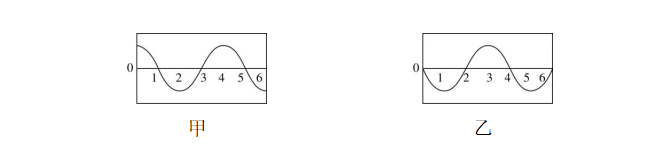
3.如图所示,甲、乙为用频闪照相机连续拍摄的两张在 $ x $ 轴上 $ 0\sim 6\mathrm{m} $ 区间段简谐波的照片.已知波沿 $ x $ 轴传播,甲照片是在 $ t=1\mathrm{s} $ 时拍摄的,乙照片是在 $ t=2\mathrm{s} $ 时拍摄的,波的周期大于 $ \dfrac{1}{3}\mathrm{s} $ ,由照片可知( )
(多选)
A.该波的波长为 $ 4\mathrm{m} $
B.该波的周期可能为 $ 1\mathrm{s} $
C.该波的频率可能为 $ 2\mathrm{H}\mathrm{z} $
D.该波可能以 $ 9\mathrm{m}/\mathrm{s} $ 的波速沿 $ x $ 轴负方向传播
由题图知,波长 $ \lambda =4\mathrm{m} $ ,故 $ \mathrm{A} $ 正确;只根据题中信息无法判断波的传播方向.若波沿 $ x $ 轴正方向传播,则有 $ \mathrm{\Delta }t=1\mathrm{s}=(n+\dfrac{3}{4})T(n=0,1,2,\cdots ) $ ,可得 $ T=\dfrac{4}{4n+3}\mathrm{s}(n=0,1,2,\cdots ) $ ,由题意知 $ T > \dfrac{1}{3}\mathrm{s} $ ,当 $ n=0 $ 时,周期 $ {T}_{1}=\dfrac{4}{3}\mathrm{s} $ ,则波速 $ {v}_{1}=\dfrac{\lambda }{{T}_{1}}=3\mathrm{m}/\mathrm{s} $ ,当 $ n=1 $ 时,周期 $ {T}_{2}=\dfrac{4}{7}\mathrm{s} $ ,则波速 $ {v}_{2}=\dfrac{\lambda }{{T}_{2}}=7\mathrm{m}/\mathrm{s} $ ,当 $ n=2 $ 时,周期 $ {T}_{3}=\dfrac{4}{11}\mathrm{s} $ ,则波速 $ {v}_{3}=\dfrac{\lambda }{{T}_{3}}=11\mathrm{m}/\mathrm{s} $ ;若波沿 $ x $ 轴负方向传播,则有 $ \mathrm{\Delta }t=1\mathrm{s}=(n+\dfrac{1}{4})T^\prime (n=0,1,2,\cdots ) $ ,可得 $ T^\prime =\dfrac{4}{4n+1}\mathrm{s}(n=0,1,2,\cdots ) $ ,由题意知 $ T^\prime > \dfrac{1}{3}\mathrm{s} $ ,当 $ n=0 $ 时,周期 $ T{\prime }_{1}=4\mathrm{s} $ ,则波速 $ v{\prime }_{1}=\dfrac{\lambda }{T{\prime }_{1}}=1\mathrm{m}/\mathrm{s} $ ,当 $ n=1 $ 时,周期 $ T{\prime }_{2}=\dfrac{4}{5}\mathrm{s} $ ,则波速 $ v{\prime }_{2}=\dfrac{\lambda }{T{\prime }_{2}}=5\mathrm{m}/\mathrm{s} $ ,当 $ n=2 $ 时,周期 $ T{\prime }_{3}=\dfrac{4}{9}\mathrm{s} $ ,则波速 $ v{\prime }_{3}=\dfrac{\lambda }{T{\prime }_{3}}=9\mathrm{m}/\mathrm{s} $ ,该波的频率 $ f=\dfrac{1}{T} $ ,不可能为 $ 2\mathrm{H}\mathrm{z} $ , $ \mathrm{B} $ 、 $ \mathrm{C} $ 错误, $ \mathrm{D} $ 正确.
4.如图所示,实线是一列简谐横波在 $ {t}_{1} $ 时刻的波形图,虚线是在 $ {t}_{2}={t}_{1}+0.5\mathrm{s} $ 时刻的波形图.下列说法正确的是( )

A.当波沿 $ x $ 轴负方向传播时,波速的表达式为 $ v=4(4n+1)\mathrm{m}/\mathrm{s}(n=0,1,2,\cdots ) $
B.当波沿 $ x $ 轴负方向传播且 $ 3T < ({t}_{2}-{t}_{1}) < 4T $ 时,波速大小为 $ 60\mathrm{m}/\mathrm{s} $
C.当波沿 $ x $ 轴正方向传播时,波速的表达式为 $ v=4(4n+3)\mathrm{m}/\mathrm{s}(n=0,1,2,\cdots ) $
D.若波速 $ v=68\mathrm{m}/\mathrm{s} $ ,则波沿 $ x $ 轴负方向传播
根据题意,由题图可知,当波沿 $ x $ 轴负方向传播时,波在 $ t={t}_{2}-{t}_{1}=0.5\mathrm{s} $ 时间内传播的距离为 $ x=\dfrac{3}{4}\lambda +n\lambda (n=0,1,2,\cdots ) $ ,由题图可知 $ \lambda =8\mathrm{m} $ ,又 $ v=\dfrac{x}{t} $ ,联立可得 $ v=4(4n+3)\mathrm{m}/\mathrm{s}(n=0,1,2,\cdots ) $ ,若有 $ 3T < ({t}_{2}-{t}_{1}) < 4T $ ,则波的传播距离范围为 $ 3\lambda < x < 4\lambda $ ,即 $ n=3 $ ,此时波速为 $ v=4×(4×3+3)\mathrm{m}/\mathrm{s}=60\mathrm{m}/\mathrm{s} $ ,故 $ \mathrm{A} $ 错误, $ \mathrm{B} $ 正确;根据题意,由题图可知,当波沿 $ x $ 轴正方向传播时,波在 $ t={t}_{2}-{t}_{1}=0.5\mathrm{s} $ 时间内传播的距离为 $ x=\dfrac{1}{4}\lambda +n\lambda (n=0,1,2,\cdots ) $ ,则波速 $ v=4(4n+1)\mathrm{m}/\mathrm{s}(n=0,1,2,\cdots ) $ ,故 $ \mathrm{C} $ 错误;若波速 $ v=68\mathrm{m}/\mathrm{s} $ ,当 $ n=4 $ 时,满足 $ v=4(4n+1)\mathrm{m}/\mathrm{s} $ ,故波沿 $ x $ 轴正方向传播,故 $ \mathrm{D} $ 错误.
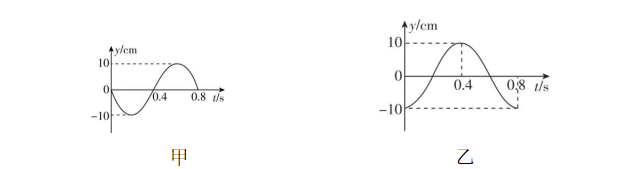
5.一列简谐横波沿 $ x $ 轴传播, $ a $ 、 $ b $ 为 $ x $ 轴上相距为 $ 1.2\mathrm{m} $ 的两质点, $ a $ 、 $ b $ 两质点振动图像分别如图甲、乙所示.

(1) 求该简谐横波的波长;
(2) 若该简谐横波的传播速度为 $ 1.2\mathrm{m}/\mathrm{s} $ ,通过计算判断该波的传播方向.
(1) 若波由 $ a $ 向 $ b $ 传播, $ \lambda =\dfrac{4.8}{4n+3}\mathrm{m}(n=0,1,2,\cdots ) $ ;若波由 $ b $ 向 $ a $ 传播, $ \lambda =\dfrac{4.8}{4n+1}\mathrm{m}(n=0,1,2,\cdots ) $
(2) 波由 $ b $ 向 $ a $ 传播
(1) 若波由 $ a $ 向 $ b $ 传播,有 $ \mathrm{\Delta }x=(n+\dfrac{3}{4})\lambda =1.2\mathrm{m}(n=0,1,2,\cdots ) $ ,
可得该简谐横波的波长 $ \lambda =\dfrac{4.8}{4n+3}\mathrm{m}(n=0,1,2,\cdots ) $ ,
若波由 $ b $ 向 $ a $ 传播,有 $ \mathrm{\Delta }x=(n+\dfrac{1}{4})\lambda =1.2\mathrm{m}(n=0,1,2,\cdots ) $ ,
可得该简谐横波的波长 $ \lambda =\dfrac{4.8}{4n+1}\mathrm{m}(n=0,1,2,\cdots ) $ .
(2) 由振动图像可知 $ T=0.8\mathrm{s} $ ,
若波由 $ a $ 向 $ b $ 传播,则波速为 $ v=\dfrac{\lambda }{T}=\dfrac{6}{4n+3}\mathrm{m}/\mathrm{s}(n=0,1,2,\cdots ) $ ,
波速不可能为 $ 1.2\mathrm{m}/\mathrm{s} $ ,
若波由 $ b $ 向 $ a $ 传播,则波速为 $ v=\dfrac{\lambda }{T}=\dfrac{6}{4n+1}\mathrm{m}/\mathrm{s}(n=0,1,2,\cdots ) $ ,
当 $ n=1 $ 时,波速为 $ 1.2\mathrm{m}/\mathrm{s} $ ,
故若该简谐横波的传播速度为 $ 1.2\mathrm{m}/\mathrm{s} $ ,波由 $ b $ 向 $ a $ 传播.
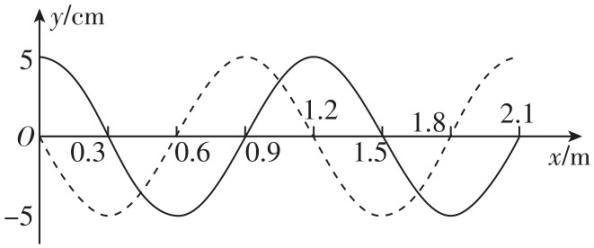
6.如图所示,实线和虚线分别是沿 $ x $ 轴方向传播的一列简谐横波在 $ {t}_{1}=0 $ 和 $ {t}_{2}=0.12\mathrm{s} $ 时刻的波形图.

(1) 求该波的波长 $ \lambda $ ,可能的周期 $ T $ ;
(2) 若 $ T < 0.12\mathrm{s} < 2T $ ,求该波的速度大小 $ {v}_{0} $ ;
(3) 求在满足(2)的条件下原点 $ O $ 的振动方程.
(1) $ \lambda =1.2\mathrm{m} $ , $ T=\dfrac{0.48}{4n+1}\mathrm{s}(n=0,1,2,\cdots ) $ 或 $ T=\dfrac{0.48}{4n+3}\mathrm{s}(n=0,1,2,\cdots ) $
(2) 若波沿 $ x $ 轴正向传播, $ {v}_{0}=17.5\mathrm{m}/\mathrm{s} $ ;若波沿 $ x $ 轴负向传播, $ {v}_{0}=12.5\mathrm{m}/\mathrm{s} $
(3) 若波沿 $ x $ 轴正向传播, $ y=5 \cos \dfrac{175\mathrm{\pi }}{6}t(\mathrm{c}\mathrm{m}) $ ;若波沿 $ x $ 轴负向传播, $ y=5 \cos \dfrac{125\mathrm{\pi }}{6}t(\mathrm{c}\mathrm{m}) $
(1) 由题图可知,该波的波长为 $ \lambda =1.2\mathrm{m} $ ,
若该波沿 $ x $ 轴正向传播,则有 $ {t}_{2}-{t}_{1}=\dfrac{3}{4}T+nT(n=0,1,2,\cdots ) $ ,整理可得 $ T=\dfrac{0.48}{4n+3}\mathrm{s}(n=0,1,2,\cdots ) $ ,
若该波沿 $ x $ 轴负向传播,则有 $ {t}_{2}-{t}_{1}=\dfrac{1}{4}T+nT(n=0,1,2,\cdots ) $ ,整理可得 $ T=\dfrac{0.48}{4n+1}\mathrm{s}(n=0,1,2,\cdots ) $ .
(2) 根据题意可知,若 $ T < 0.12\mathrm{s} < 2T $ ,
则有 $ n=1 $ ,
若该波沿 $ x $ 轴正向传播,则有 $ T=\dfrac{0.48}{4+3}\mathrm{s}=\dfrac{0.48}{7}\mathrm{s} $ ,
该波的速度大小为 $ {v}_{0}=\dfrac{\lambda }{T}=17.5\mathrm{m}/\mathrm{s} $ ,
若该波沿 $ x $ 轴负向传播,则有 $ T=\dfrac{0.48}{4+1}\mathrm{s}=\dfrac{0.48}{5}\mathrm{s} $ ,
该波的速度大小为 $ {v}_{0}=\dfrac{\lambda }{T}=12.5\mathrm{m}/\mathrm{s} $ .
(3) 由题图可知该波的振幅为 $ 5\mathrm{c}\mathrm{m} $ ,若该波沿 $ x $ 轴正向传播,则有 $ \omega =\dfrac{2\mathrm{\pi }}{T}=\dfrac{175\mathrm{\pi }}{6}\mathrm{r}\mathrm{a}\mathrm{d}/\mathrm{s} $ ,
则原点 $ O $ 的振动方程为 $ y=5 \cos \dfrac{175\mathrm{\pi }}{6}t(\mathrm{c}\mathrm{m}) $ ,
若该波沿 $ x $ 轴负向传播,则有 $ \omega =\dfrac{2\mathrm{\pi }}{T}=\dfrac{125\mathrm{\pi }}{6}\mathrm{r}\mathrm{a}\mathrm{d}/\mathrm{s} $ ,
则原点 $ O $ 点的振动方程为 $ y=5 \cos \dfrac{125\mathrm{\pi }}{6}t(\mathrm{c}\mathrm{m}) $ .
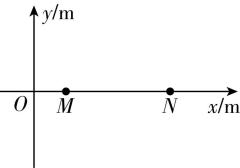
7.有一个小朋友坐着船欣赏西湖的风光时,发现在不远处平静湖面上有两片小树叶,他为了让这两片小树叶振动起来,往水中丢了一块小石子,丢石子的位置与两片小树叶处在同一条水平直线上,在水中形成了机械波(简谐横波).如图所示,坐标原点 $ O $ 为丢石子的位置, $ M $ 、 $ N $ 为两片小树叶的位置,他发现 $ M $ 处树叶比 $ N $ 处树叶先振动,当 $ M $ 处树叶运动到波峰时, $ N $ 处树叶刚好运动到波谷.假设 $ M $ 、 $ N $ 两处树叶平衡位置之间的距离为 $ 0.45\mathrm{m} $ .则这列水波的波长不可能是( )

A. $ 0.90\mathrm{m} $
B. $ 0.60\mathrm{m} $
C. $ 0.30\mathrm{m} $
D. $ 0.10\mathrm{m} $
$ M $ 、 $ N $ 两处树叶平衡位置相距 $ 0.45\mathrm{m} $ ,当 $ M $ 处树叶运动到波峰时, $ N $ 处树叶刚好运动到波谷,有 $ (n+\dfrac{1}{2})\lambda =0.45\mathrm{m}(n=0,1,2,\cdots ) $ ,解得 $ \lambda =\dfrac{0.90}{2n+1}\mathrm{m}(n=0,1,2,\cdots ) $ ,可知 $ n=0 $ 时 $ \lambda =0.90\mathrm{m} $ , $ n=1 $ 时 $ \lambda =0.30\mathrm{m} $ , $ n=4 $ 时 $ \lambda =0.10\mathrm{m} $ ,故选 $ \mathrm{B} $ .
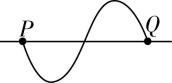
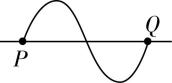
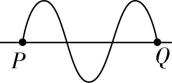
8.如图所示,一列振幅为 $ 10\mathrm{c}\mathrm{m} $ 的简谐横波,其传播方向上有两个质点 $ P $ 和 $ Q $ ,两者的平衡位置相距 $ 3\mathrm{m} $ .某时刻两质点均在平衡位置且两者之间只有一个波谷,再经过 $ 0.3\mathrm{s} $ , $ Q $ 第一次到达波峰.则下列说法不正确的是( )

A.波长可能为 $ 2\mathrm{m} $
B.周期可能为 $ 0.24\mathrm{s} $
C.波速可能为 $ 15\mathrm{m}/\mathrm{s} $
D. $ 0.3\mathrm{s} $ 内质点 $ P $ 的位移大小为 $ 10\mathrm{c}\mathrm{m} $
根据题意, $ P $ 、 $ Q $ 之间的波形图可能有如图所示的几种情况,当 $ P $ 、 $ Q $ 之间有一个波谷两个波峰时,如图3,则有 $ \dfrac{3}{2}{\lambda }_{3}=3\mathrm{m} $ ,解得 $ {\lambda }_{3}=2\mathrm{m} $ ,故 $ \mathrm{A} $ 正确;根据波形图,由于波的传播方向不确定,故质点 $ Q $ 第一次到达波峰经历的时间可能为 $ \dfrac{1}{4}T=0.3\mathrm{s} $ 或 $ \dfrac{3}{4}T=0.3\mathrm{s} $ ,解得 $ T=1.2\mathrm{s} $ 或 $ T=0.4\mathrm{s} $ ,故 $ \mathrm{B} $ 错误;图1、2、3、4的波长分别为 $ {\lambda }_{1}={\lambda }_{2}=3\mathrm{m} $ 、 $ {\lambda }_{3}=2\mathrm{m} $ 、 $ {\lambda }_{4}=6\mathrm{m} $ ,当周期为 $ 1.2\mathrm{s} $ 时,根据周期与波速之间的关系 $ v=\dfrac{\lambda }{T} $ ,可得 $ {v}_{1}={v}_{2}=2.5\mathrm{m}/\mathrm{s} $ , $ {v}_{3}=\dfrac{5}{3}\mathrm{m}/\mathrm{s} $ , $ {v}_{4}=5\mathrm{m}/\mathrm{s} $ ,当周期为 $ 0.4\mathrm{s} $ 时,可得波速为 $ v{\prime }_{1}=v{\prime }_{2}=7.5\mathrm{m}/\mathrm{s} $ , $ v{\prime }_{3}=5\mathrm{m}/\mathrm{s} $ , $ v{\prime }_{4}=15\mathrm{m}/\mathrm{s} $ ,故 $ \mathrm{C} $ 正确;经过 $ 0.3\mathrm{s} $ ,当质点 $ Q $ 到达波峰时,图1、2中质点 $ P $ 到达波峰,图3、4中质点 $ P $ 到达波谷,因此 $ 0.3\mathrm{s} $ 内质点 $ P $ 的位移大小为 $ 10\mathrm{c}\mathrm{m} $ ,故 $ \mathrm{D} $ 正确.故选 $ \mathrm{B} $ .


图1图2图3图4
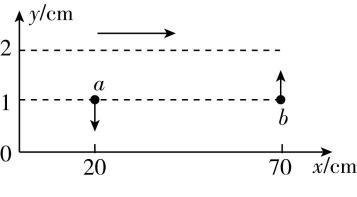
9.一列简谐横波沿 $ x $ 轴正方向传播,振幅为 $ 2\mathrm{c}\mathrm{m} $ ,周期为 $ T $ .已知 $ t=0 $ 时刻波上平衡位置相距 $ 50\mathrm{c}\mathrm{m} $ 的两质点 $ a $ 、 $ b $ 的位移都是 $ 1\mathrm{c}\mathrm{m} $ ,但运动方向相反,其中质点 $ a $ 沿 $ y $ 轴负方向运动,如图所示,下列说法正确的是( )
(多选)
A.该列简谐横波波长可能为 $ 150\mathrm{c}\mathrm{m} $
B.该列简谐横波波长可能为 $ 12\mathrm{c}\mathrm{m} $
C.当质点 $ b $ 的位移为 $ 2\mathrm{c}\mathrm{m} $ 时,质点 $ a $ 的位移为正
D.在 $ t=\dfrac{5T}{12} $ 时刻质点 $ b $ 的速度最大
简谐横波沿 $ x $ 轴正方向传播, $ t=0 $ 时刻,质点 $ a $ 、 $ b $ 的位移均为 $ 1\mathrm{c}\mathrm{m} $ (振幅为 $ A=2\mathrm{c}\mathrm{m}) $ ,运动方向相反,由振动方程 $ y=A \sin (\omega t+\varphi ) $ ,代入 $ y=1\mathrm{c}\mathrm{m} $ 得 $ \sin \varphi =\dfrac{1}{2} $ ,若 $ \omega t=0 $ ,质点从平衡位置沿 $ y $ 轴正方向起振,则 $ a $ 、 $ b $ 两质点的相位分别为 $ \dfrac{5\mathrm{\pi }}{6} $ 和 $ \dfrac{\mathrm{\pi }}{6} $ ,相位差 $ \mathrm{\Delta }\varphi =\dfrac{5\mathrm{\pi }}{6}-\dfrac{\mathrm{\pi }}{6}=\dfrac{2\mathrm{\pi }}{3} $ ,考虑波传播的周期性,可得出 $ \mathrm{\Delta }x=(n+\dfrac{\mathrm{\Delta }\varphi }{2\mathrm{\pi }})\lambda =(n+\dfrac{1}{3})\lambda (n=0,1,2,\cdots ) $ ,可得波长为 $ \lambda =\dfrac{150}{3n+1}\mathrm{c}\mathrm{m}(n=0,1,2,\cdots ) $ ,当 $ n=0 $ 时 $ \lambda =150\mathrm{c}\mathrm{m} $ ,由于 $ n $ 是整数,所以 $ \lambda $ 不可能为 $ 12\mathrm{c}\mathrm{m} $ , $ \mathrm{A} $ 正确, $ \mathrm{B} $ 错误;当质点 $ b $ 的位移为 $ 2\mathrm{c}\mathrm{m} $ ,即 $ b $ 到达波峰时,结合波形知,质点 $ a $ 在平衡位置下方,位移为负, $ \mathrm{C} $ 错误;由题意可知质点 $ b $ 的振动方程为 $ y=2 \sin (\dfrac{2\mathrm{\pi }}{T}t+\dfrac{\mathrm{\pi }}{6})(\mathrm{c}\mathrm{m}) $ ,当 $ t=\dfrac{5T}{12} $ 时, $ y=0 $ ,即质点 $ b $ 到达平衡位置处,速度最大, $ \mathrm{D} $ 正确.